



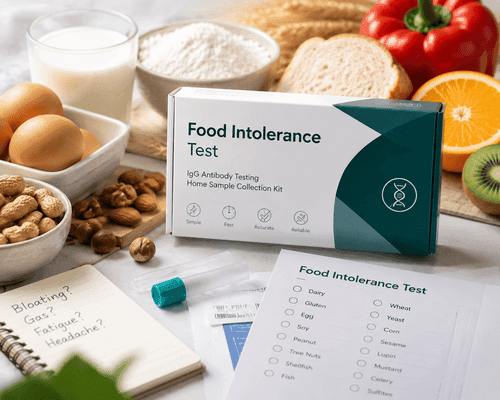
Why Do I Feel Bloated After Every Meal? Could Food Intolerance Be the Cause?
Does your meal end before the discomfort begins?
You eat your meal as usual, and shortly afterwards, you start experiencing bloating, gas, or a feeling of heaviness in your stomach. Sometimes it may be accompanied by cramps or diarrhoea, while other times it may simply feel like uncomfortable fullness without an obvious explanation.
If this happens repeatedly after most meals, it’s natural to start wondering: could there be a food your body doesn’t tolerate?
Food intolerance may be one possibility, but it isn’t the only explanation. Bloating can also be linked to eating too quickly, large meals, certain digestive conditions, constipation, or certain types of carbohydrates that can be difficult for some people to digest.
Most importantly, food intolerance is not the same as a food allergy. Understanding the difference is the first step before you start eliminating large groups of foods from your diet.
What Is Food Intolerance?
Food intolerance means that your body has difficulty digesting a particular food or one of its components. Symptoms often appear after eating and may include bloating, gas, abdominal pain, diarrhoea or constipation, and sometimes nausea or fatigue.
One of the most common examples is lactose intolerance, where the body has difficulty digesting lactose, the sugar found in milk and some dairy products, because of a lack of the enzyme lactase.
But lactose isn’t the only possibility. Some people may notice symptoms associated with certain food ingredients or with consuming large amounts of particular foods. There is therefore no single answer that applies to everyone.
And this is where things can get confusing: if you experience bloating regularly, it can be easy to blame the last meal you ate. But the last food you consumed isn’t always the actual cause.
Does Bloating After Eating Mean I Have a Food Intolerance?
Not necessarily. Bloating is very common and can have many different causes. It can happen after a large or quickly eaten meal, with certain foods that increase gas, or as a result of constipation or certain digestive issues.
Likewise, if bloating is your only symptom, it does not automatically mean that you have a food allergy. A true food allergy usually involves an immune response and may cause symptoms such as itching, a rash, swelling of the lips or face, wheezing or difficulty breathing, in addition to digestive symptoms.
So instead of asking yourself, “What food should I stop eating?”, a better question may be: “What pattern do my symptoms follow, and does this warrant a medical evaluation?”
Food Intolerance or Food Allergy? Here’s the Difference
The two can seem similar, but understanding the difference between food intolerance and food allergy is important.
With food intolerance, the problem is usually related to the way the body digests a food or one of its components. Symptoms can be uncomfortable, but they do not typically represent a dangerous allergic reaction.
A food allergy, on the other hand, is an immune system response to a specific protein in food. In some cases, it can be severe. Common food allergens include milk, eggs, peanuts, fish, shellfish, soy, tree nuts, and wheat.
This distinction is more than just a medical detail. If you have ever experienced throat swelling, difficulty breathing, or severe dizziness after eating a particular food, don’t assume it is simply an intolerance.
These symptoms may indicate a food allergy and require appropriate medical evaluation.
In Saudi Arabia, food regulations require food establishments to disclose a number of allergens on menus, including cereals containing gluten, milk, eggs, fish, crustaceans, nuts, peanuts, sesame, and others.
What Symptoms May Point to Food Intolerance?
There is no single set of symptoms that applies to everyone, but some of the most common include:
Bloating and a feeling of fullness
Gas
Abdominal pain or cramps
Diarrhoea or constipation
Nausea
General discomfort after eating certain foods
Food intolerance symptoms often appear some time after eating and may last for several hours or even days, depending on the cause and the individual.
What makes things confusing is that symptoms may not appear in exactly the same way every time. You may eat a particular food today without any problems and then experience bloating after eating it on another day.
That doesn’t necessarily mean your body has “changed its mind.” The amount of food, what you ate alongside it, how the meal was prepared, and other factors can all influence your symptoms.
Which Foods Could Be Causing the Problem?
This varies from person to person, but some common examples include:
1. Dairy products: Particularly in people who have lactose intolerance.
2. Certain grains and food ingredients: Some people associate their symptoms with foods containing wheat or certain ingredients. However, it is important not to assume that every issue with wheat means a gluten allergy or coeliac disease.
3. Certain additives or ingredients: Some ingredients found in processed foods may trigger symptoms in certain people. This is why it is important to avoid thinking in terms of “bad foods.” A food that causes problems for one person may be completely fine for another.
How Can I Identify the Food Causing My Bloating?
Start with the simplest step: look for a pattern.
For one to two weeks, keep track of what you eat and when your symptoms begin. You don’t need to write lengthy food diaries; simply record:
What did you eat?
Approximately how much did you eat?
When did the symptoms begin?
What symptoms appeared?
Did they happen more than once after eating the same food?
This type of tracking can help your doctor or dietitian see the bigger picture rather than relying on a single impression.
It can also be useful to notice whether the problem is linked to a particular amount of food. Sometimes the food itself may not be the issue; it may be the quantity you consumed.
Is There a Food Intolerance Test in Riyadh?
Yes, tests are available in Riyadh and Saudi Arabia that are marketed to assess reactions to different types of foods. However, it is very important to understand what a test actually measures before relying on its results.
Valeo Health offers a food intolerance test in Riyadh that measures IgG antibody reactivity to more than 200 different foods. However, there is an important point to understand: the presence of IgG antibodies to a particular food, by itself, does not mean that you have an allergy or intolerance to that food.
Therefore, when choosing a Gut health test in Riyadh, don’t look only at the name of the test. Ask what type of test it is, exactly what it measures, how the results will be interpreted, and whether additional medical evaluation may be required. This small step can help prevent you from unnecessarily removing dozens of foods from your diet based on a result that may not mean what you think it does.
What About a Food Allergy Test in Riyadh?
The term “food allergy testing” can refer to different conditions and types of tests, rather than one specific medical test.
Instead of simply asking, “Which test do I need?”, it is better to ask: “What type of test is this, and what condition can it actually diagnose?”
This is particularly important when symptoms are persistent, because bloating may be linked to a condition that requires an entirely different type of evaluation.
When Do I Need a Food Allergy Test in Riyadh?
If your symptoms after eating a particular food include a rash or itching, swelling of the lips, face or tongue, wheezing or difficulty breathing, repeated vomiting, or symptoms that are rapid or severe, it is not enough to treat the issue as food intolerance.
True allergy testing may include skin-prick testing or a blood test for food-specific IgE antibodies. A doctor determines the appropriate test based on your medical history and symptoms. Allergy test results should not be interpreted on their own without considering your symptoms and food history.
In some cases, an allergist may use an oral food challenge under medical supervision to confirm a diagnosis. This should not be attempted at home, especially when there is a possibility of a severe allergic reaction.
Can I Eliminate Foods on My Own?
An elimination and reintroduction diet can be useful in some cases of food intolerance, but it is best done in a structured way with medical or dietary guidance, particularly if you plan to eliminate several food groups.
The reason is simple: removing milk, wheat, eggs, nuts, and other foods all at once can make it difficult to determine which food was actually associated with your symptoms. It may also lead to an unnecessarily restrictive diet.
Health guidance suggests that elimination and reintroduction can form part of an intolerance assessment, with the important caveat that foods should not be removed randomly or for long periods without appropriate professional guidance.
Can I Get a Food Intolerance Test From Home?
Health testing no longer always requires a trip to a laboratory. With at-home testing services, you can provide your sample from the comfort of your home, making the process more convenient, particularly if recurring bloating or digestive symptoms are prompting you to look for answers.
But what matters isn’t whether the test is done at home or in a laboratory. What matters is understanding what it measures, how the sample is collected, and how the result should be interpreted.
Valeo Health offers an at-home food intolerance test, which measures IgG antibody reactivity to more than 200 different foods. The service is part of Valeo Health’s at-home healthcare options in Riyadh, providing a more convenient way to take the test without having to visit a laboratory.
However, it is important to treat the result as one part of the bigger picture rather than as a standalone diagnosis. If you experience recurring bloating or other symptoms after eating, the result may help you better understand patterns in your diet, but it should be discussed with a healthcare professional when appropriate before eliminating multiple foods from your diet.
In other words, the convenience of testing from home does not mean the result should be considered on its own. What matters most is understanding it in the context of your symptoms and eating patterns.
Explore Valeo Health's at-home food intolerance testing in Riyadh
What If the Bloating Continues Despite Changing Your Diet?
If you feel bloated after almost every meal, it is a mistake to immediately assume that you have a “food allergy.”
There may be other underlying causes that need to be evaluated, which is why it can be helpful to look at your digestive health more broadly.
At Valeo Health, for example, you can access the Valeo Digestive Health & 360° Wellbeing Program, along with at-home health tests and consultations.
The goal is not to undergo as many tests as possible, but to choose the test or evaluation that actually answers the question you have.
When Should I Not Ignore Bloating?
Occasional bloating after a heavy meal is one thing. Bloating that keeps coming back is another.
If your symptoms are recurring or affecting your daily life, it is better to discuss them with a doctor or healthcare professional rather than continuing to guess.
And if you experience severe allergic symptoms such as swelling of the throat or tongue, difficulty breathing, or severe dizziness after eating, this requires urgent medical attention.
In Conclusion
If you experience bloating after almost every meal, it is completely natural to look for an answer. But the solution is not necessarily to eliminate half the foods in your kitchen or rely on the first test you come across in a search result.
Start by identifying patterns, understand the difference between food intolerance and food allergy, and seek medical evaluation when symptoms are persistent or unclear.
If you are in Riyadh and looking for a food intolerance test in Riyadh, you can explore the at-home testing options available through Valeo Health and then discuss the results with the appropriate healthcare professional rather than making major dietary changes based on a single result.
Ultimately, the goal is not to make you afraid of food. The goal is to understand your body better and know what it actually needs.
Medically Reviewed By: Dr. Rayan Mohammed, General Practitioner at Valeo Health
Reviewed for medical accuracy, safety guidelines, and healthcare recommendations.
Frequently Asked Questions
1. Is bloating after eating a sign of food intolerance?
It can be, but bloating alone is not enough to confirm food intolerance. Bloating has many possible causes, so the pattern of recurring symptoms and their relationship to specific foods or ingredients is more important than the presence of bloating itself.
2. What is the difference between food intolerance and food allergy?
Food intolerance is generally associated with difficulty digesting a particular food or ingredient, while a food allergy involves an immune response to a specific component of food. The two conditions are therefore not the same, and one test cannot be used to diagnose both.
3. Can IgG antibodies diagnose a food allergy?
No. Elevated IgG antibodies to a particular food should not be considered a diagnosis of food allergy test in Riyadh. You should also not eliminate multiple foods from your diet based solely on an IgG result.
4. Do I need to fast before a food intolerance test?
Preparation requirements depend on the type of test and the sample required. It is therefore best to follow the specific instructions provided by the healthcare provider conducting the test rather than assuming that all tests have the same preparation requirements.
5. Could I have lactose intolerance?
Yes. Lactose intolerance is one of the most common types of food intolerance. It may cause bloating, gas, abdominal pain, and diarrhoea after consuming milk or dairy products in people who have difficulty digesting lactose. Specialised tests, such as a breath test in some cases, may be used to help with the evaluation.
6. Should I stop eating gluten if I experience bloating?
Not necessarily. Bloating alone does not mean that you have a gluten intolerance, and coeliac disease is a separate condition that requires appropriate evaluation and diagnosis. It is therefore not recommended to start a gluten-free diet randomly before speaking with a healthcare professional, particularly if coeliac disease is suspected.
7. Where can I get a food intolerance test in Riyadh?
Valeo Health offers at-home testing services in Riyadh, including a food intolerance test that measures IgG antibody reactivity to more than 200 different foods, along with other services related to digestive health and allergies.