



Urologist, Laboratory, or At-Home Testing? Where to Get an STD Test in Medina
Deciding to get tested for sexually transmitted diseases (STDs) is one of the most responsible health decisions anyone can make. But the next question is just as important: Where should you go? Should you book an appointment with a urologist? Is visiting a private laboratory enough? Or is the smartest option today to use an at-home healthcare provider that comes to you instead?
This question is more important than it seems. The option you choose directly affects how quickly you receive your results, the level of privacy you maintain, the cost you'll pay, and most importantly, whether you'll receive the right medical guidance if your results are positive.
In a city like Medina, where healthcare options range from urology departments in major hospitals to fast private laboratories and rapidly growing home healthcare services, understanding the differences between these options can save you time, money, and unnecessary stress.
In this comprehensive guide, we'll cover everything you need to know about STD testing in Medina: what each option offers, when you should see a urologist, when a private laboratory is sufficient, how home healthcare services work, and how to choose the right provider for your needs.
Why Testing Is More Important Than You Think
Many sexually transmitted infections (STIs) are silent. A person may carry chlamydia, gonorrhea, or even HIV for weeks, months, or sometimes years without experiencing any symptoms. That's exactly why relying on "feeling fine" is not a safe strategy.
Undetected infections can lead to:
- Infertility in both men and women.
- Chronic pelvic pain.
- Increased risk of certain cancers, particularly those associated with HPV.
- Serious pregnancy complications.
- Permanent damage to organs if left untreated.
Routine testing—especially after a new sexual partner, unprotected sexual contact, or the appearance of unusual symptoms—is not a sign of recklessness. It's a sign that you're taking your health and the health of others seriously.
How Often Should You Get Tested?
- Sexually active people in a long-term monogamous relationship: Once a year, or as recommended by your physician.
- People with multiple or new partners: Every 3–6 months.
- Before marriage: A comprehensive STD screening is strongly recommended before marriage. In many cases, it complements Saudi Arabia's official premarital health screening.
- After unprotected sexual contact or if symptoms develop: Get tested as soon as possible.
However, it's important to understand that some tests—particularly HIV tests—have a window period, which may last from two weeks to several weeks after exposure. During this time, results may not be fully accurate. Even if you test early, your healthcare provider or laboratory may recommend repeating the test after the window period to confirm your result.
Key STI Tests Available in Medina
Regardless of where you choose to get tested, a range of tests is generally available to screen for the most common sexually transmitted infections (STIs), including:
- HIV test
- Syphilis test
- Chlamydia test
- Gonorrhea test
- Hepatitis B test
- Hepatitis C test
- Herpes simplex virus (HSV) test
- Human papillomavirus (HPV) test, which is recommended in certain cases based on a doctor’s assessment
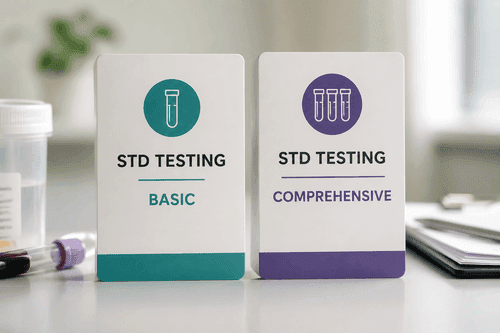
Many private laboratories and at-home healthcare providers also offer comprehensive packages that include multiple tests in a single visit, making it easier to complete the tests needed based on each individual’s needs and healthcare provider’s recommendations.
Your Testing Options in Medina
There are many testing options in Medina, it is important to know them all before you make a decision as every option has its own strengths and limitations.
Option 1: Visit a Urologist
A urologist specializes in the urinary tract and male reproductive system. In Saudi Arabia, many men choose to consult a urologist for concerns related to sexual health because of the close connection between the specialty and male reproductive health.
What Does a Urology Appointment Usually Include?
- A complete medical consultation discussing symptoms, sexual history, and risk factors in a confidential, judgment-free setting.
- A physical examination to check for sores, discharge, swelling, rashes, or other visible signs.
- Ordering the appropriate laboratory tests, including blood work, urine analysis, or swabs depending on the suspected infection.
- Immediate clinical interpretation of symptoms, even before laboratory results are available.
- A treatment plan if an infection is confirmed, with medication often prescribed during the same visit.
When Is a Urologist the Best Choice?
Choose a urologist if:
- You have obvious symptoms such as painful urination, unusual discharge, sores, itching, swelling, pelvic pain, or testicular pain.
- You need a clinical diagnosis rather than just laboratory numbers.
- You want treatment to begin immediately if your test is positive.
- You experience recurrent infections and need to investigate the underlying cause.
- You want expert advice on how the results may affect your fertility and long-term health.
Option 2: Visit a Private Laboratory
Private laboratories have become increasingly popular across Saudi Arabia, including Medina, because they offer what many people value most: speed and privacy, without needing a lengthy doctor's consultation.
What Happens During a Laboratory Visit?
- Online or direct booking, often without requiring a physician referral.
- Blood or urine collection by a trained laboratory technician within minutes.
- Digital results are sent securely to your phone or online portal, usually within 24–72 hours depending on the test.
- No mandatory consultation—you simply choose the tests you want, such as HIV, syphilis, hepatitis B & C, chlamydia, or gonorrhea.
When Is a Private Laboratory the Best Choice?
A laboratory is ideal if:
- You have no symptoms and simply want routine screening.
- You value privacy and prefer minimal face-to-face discussion.
- You already know which test you need.
- You want fast results without scheduling a full medical consultation.
- You're testing as a precaution after a new relationship or before marriage.
Limitations of Laboratory Testing
A laboratory can tell you what's present in your blood or urine, but it cannot physically examine you, diagnose visible symptoms, or prescribe treatment. If your results are positive, you'll still need to consult a physician—typically a urologist, gynecologist, or infectious disease specialist—for diagnosis, treatment, and follow-up. In other words, the laboratory is often the first step rather than the final destination.
Option 3: Home Healthcare Providers
In recent years, home healthcare has become one of the fastest-growing healthcare options across Saudi Arabia, especially among people seeking maximum privacy and convenience.
Instead of visiting a clinic or laboratory, a licensed healthcare professional comes to your home or office, collects your samples, and your results are delivered digitally.
What Do Home Healthcare Services Offer?
- Easy online booking through a website or mobile app.
- Sample collection at your home by licensed healthcare professionals.
- Complete privacy without visiting a clinic or laboratory.
- Secure digital results delivered electronically.
- Access to telemedicine consultations if your results require further evaluation or treatment.
When Is Home Testing the Best Option?
Choose home healthcare if:
- Privacy is your highest priority.
- You have a busy schedule and want to avoid travel.
- You live farther from major hospitals or laboratories.
- You feel uncomfortable discussing your concerns face-to-face.
- You're completing premarital screening and prefer the convenience of testing at home.
How to Choose the Right Home Healthcare Provider
Before booking, verify the following:
1. Official Licensing
Ensure the provider is licensed by the Saudi Ministry of Health or the Saudi Commission for Health Specialties.
2. Laboratory Accreditation
Confirm which accredited laboratory will analyze your samples.
3. Turnaround Time
Choose a provider that clearly states how long results will take and how they'll be delivered.
4. Patient Reviews
Read previous customer reviews, particularly regarding confidentiality and professionalism.
5. Transparent Pricing
Understand the total cost, including any home visit fees, before booking.
Which Option Is Best for You?
The honest answer is: it depends on why you're getting tested.
If you have physical symptoms—even mild ones—visit a urologist (or a gynecologist if you're a woman). Symptoms require medical evaluation, not just laboratory results.
If you don't have symptoms and simply want routine screening or premarital testing, both private laboratories and home healthcare services are excellent, fast, and reliable options.
If privacy is your highest priority, home healthcare offers the greatest level of confidentiality by combining convenience with minimal direct interaction.
If you're unsure where to begin, the safest approach is to start with a comprehensive screening through a private laboratory or home healthcare provider, then follow up with a specialist if necessary or if symptoms develop later.
Confidentiality: Everyone's Biggest Concern
One of the main reasons some people hesitate to get tested is concern about privacy, which is completely understandable. In Saudi society, privacy is highly valued when it comes to personal health matters, and all healthcare providers—including urology clinics, laboratories, and at-home healthcare services—understand this well.
Private laboratories often provide results digitally, without handing over printed reports, through secure online portals that can only be accessed using a personal code.
Urology clinics, particularly those in private hospitals and specialized clinics, follow strict medical confidentiality regulations. Your consultation or test results will not be disclosed to any third party, whether an employer or family member, without your explicit consent.
At-home healthcare providers offer the highest level of practical privacy, as the entire testing process takes place without leaving your home. Choosing a Lab Test at Home service allows you to complete STD screening comfortably and discreetly, with results delivered digitally. Valeo Health is one provider offering this service, allowing testing to be performed at home by a specialized team while maintaining confidentiality throughout every stage—from booking the appointment to receiving results electronically. This makes it a suitable option for those who consider privacy, convenience, and professional care a priority when deciding to get tested.
Final Thoughts
Your health is your most valuable asset, and prevention is always better than cure. Don’t let embarrassment or uncertainty prevent you from taking the step toward reassurance about your health.
Whether you're looking for an STD Test Riyadh service because of symptoms, routine screening, or peace of mind, choosing the right healthcare provider depends on your needs. A urologist or gynecologist is recommended if you have symptoms or require treatment, while a private laboratory or at-home healthcare provider is often the most convenient option for routine Basic STD Test Riyadh screening. At-home testing also offers greater privacy, comfort, and convenience, making it easier to prioritize your sexual health without unnecessary stress.
If you’re unsure which test is right for your situation or need a consultation before taking the first step, you can contact Valeo Health. Its medical team can connect you with a doctor who can assess your situation, answer your questions, and help you choose the most appropriate test, with the option to have testing performed at home with complete privacy and convenience.
Whatever path you choose, the most important step remains simple: get tested. Early detection not only protects your health, but also helps protect the health of your partner and family. Delaying or ignoring testing can have far greater consequences than undergoing a simple test or seeking medical advice for peace of mind.
Frequently Asked Questions
1. Can I get tested for STDs in Medina without a doctor's referral?
Yes. Most private laboratories and home healthcare providers allow direct or online booking without requiring a physician referral.
2. Does Saudi Arabia's mandatory premarital screening include all sexually transmitted diseases?
No. The official premarital screening program primarily focuses on inherited blood disorders (such as sickle cell disease and thalassemia), hepatitis B and C, and HIV. It does not routinely include common STDs such as chlamydia, gonorrhea, syphilis, or genital herpes. A comprehensive STD screening before marriage is therefore strongly recommended.
3. What should I do if my test result is positive?
Book an appointment with a urologist, gynecologist, or another qualified specialist as soon as possible. Most sexually transmitted infections are treatable, and early treatment greatly reduces the risk of complications.
4. If my result is positive, does that mean I'll never recover?
Absolutely not. Most sexually transmitted infections (STIs), especially bacterial infections such as chlamydia, gonorrhea, and syphilis, can be completely cured with the appropriate treatment. Some viral infections, such as HIV, herpes, and hepatitis B, can be effectively managed with modern treatments, helping protect your health and reduce the risk of transmission. Early diagnosis remains one of the most important factors in successful treatment.
5. Is STD testing completely confidential in Saudi Arabia?
Yes. Licensed laboratories, clinics, and home healthcare providers are legally required to protect patient confidentiality and cannot share your results with employers, family members, or any third party without your consent.
6. Is it normal to get tested even if I don't have symptoms?
Absolutely. Many sexually transmitted infections cause no symptoms during their early stages, making routine testing one of the most effective ways to protect your long-term health.
7. Can I get tested without having blood drawn?
It depends on the type of infection you want to test for. Some sexually transmitted infections (STIs) can be screened using methods that do not require a blood draw, while others require a blood test for an accurate diagnosis. Your healthcare provider will determine the most appropriate test based on your individual situation.
8. Are home healthcare services safe and reliable?
Yes, provided you choose a licensed provider that works with an accredited laboratory and delivers results through secure digital channels.
9. Do I need to fast before an STD blood test?
Usually not. Most STD blood tests do not require fasting. However, if your testing package includes additional health screenings, it's always best to confirm with the laboratory beforehand.
10. Can women use the same laboratories and home healthcare services?
Yes. Private laboratories and home healthcare providers serve both men and women. Women may also be advised to undergo additional screening, such as HPV testing, in consultation with a gynecologist.