

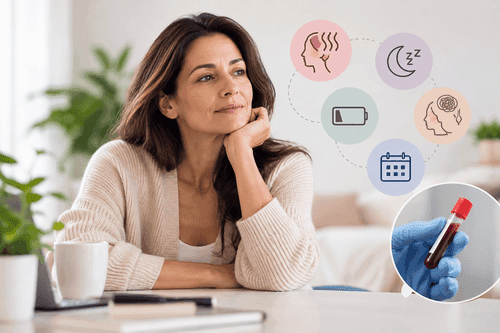
Menopause Symptoms in Your 40s: What Changes and When Should You Get Tested?
Direct Answer
Menopause symptoms can begin during perimenopause, the transitional stage leading up to menopause, which often starts in your 40s. You may notice changes in your menstrual cycle, hot flashes, night sweats, sleep problems, or changes in your mood.
However, experiencing these symptoms does not necessarily mean you have reached menopause. Menopause is generally defined as going 12 consecutive months without a period, provided there is no other reason for your periods to have stopped.
Hormone tests are not necessary for everyone. Whether testing is appropriate depends on factors such as your age, symptoms, menstrual history, and overall health.
Key Takeaways
Changes associated with menopause can begin years before your periods stop completely.
Changes in your menstrual cycle are among the most common early signs.
Hot flashes are not the only symptom. Sleep, mood, concentration, and vaginal health can also be affected.
No single blood test can confirm that you are in perimenopause.
Some symptoms can overlap with other health conditions, so testing may sometimes be recommended to rule out other causes.
Any vaginal bleeding that occurs after 12 consecutive months without a period should be medically assessed.
Introduction
Menopause does not begin on a specific day, and every woman experiences the transition differently. The years leading up to menopause can involve gradual changes in hormone levels and your menstrual cycle.
This can sometimes make it difficult to know whether what you are experiencing is an expected part of the transition or something that should be checked. Understanding the different stages of menopause, what changes are common, and when testing may be useful can help you make informed decisions without relying on age alone.
What Is the Difference Between Perimenopause and Menopause?
The terms are often used interchangeably, but they describe different stages.
Perimenopause is the transitional period leading up to menopause. During this time, hormone levels fluctuate, ovulation can become less predictable, and your periods may become less regular.
Menopause is reached after you have gone 12 consecutive months without a menstrual period, provided your periods have not stopped for another reason.
What Is the Typical Age for Menopause?
There is no single menopause age that applies to everyone. Menopause typically occurs between the ages of 45 and 55, but perimenopause can begin several years earlier.
So, turning 40 does not automatically mean you are approaching menopause. What matters more is noticing changes compared with your usual menstrual cycle and how you normally feel.
What Menopause Symptoms Can Begin in Your 40s?
The experience varies from one woman to another. Changes in your menstrual cycle may be the first sign you notice, while for someone else, sleep problems or hot flashes may be more noticeable.
1. Changes in Your Menstrual Cycle
Your periods may begin to look different from your usual pattern. They may become shorter or longer, come closer together or further apart, and bleeding may become lighter or heavier. You may also skip a period and then have one again later.
However, not every change in your menstrual cycle should automatically be attributed to perimenopause, particularly if the bleeding is unusually heavy or otherwise different from your normal pattern.
2. Hot Flashes and Night Sweats
You may suddenly feel a wave of heat across your face, neck, or chest, sometimes accompanied by sweating or a racing heartbeat.
When hot flashes occur at night, they can cause you to wake repeatedly and may affect both your sleep quality and your energy the following day.
3. Sleep Changes
You may find it harder to fall asleep or stay asleep, even if sleep has never been a problem before.
Night sweats and hot flashes can contribute to disrupted sleep, while poor sleep itself may leave you feeling more tired and make it harder to concentrate.
4. Mood and Concentration Changes
You may notice increased irritability, anxiety, low mood, or difficulty concentrating. Some women also describe experiencing “brain fog.”
These symptoms are not unique to perimenopause, however, so changes in mood or concentration should not automatically be assumed to be hormonal.
5. Vaginal Dryness and Changes in Sexual Health
Lower estrogen levels can affect vaginal tissues, leading to dryness, itching, or a burning sensation.
Sex may also become uncomfortable or painful for some women, and changes in sexual desire can occur during this stage.
6. Other Changes in Your Body
Other symptoms can include headaches, muscle or joint pain, heart palpitations, and changes in your skin, hair, or weight. Experiencing one of these symptoms does not necessarily mean menopause is the cause, as many of them can be associated with other health conditions.
When Should You Consider Testing During Perimenopause?
Changes in your periods or the appearance of hot flashes do not automatically mean you need a full panel of hormone tests. During perimenopause, hormone levels naturally fluctuate. This means a blood test taken on one day may show something different from a test taken at another time.
For this reason, assessment usually considers your age, symptoms, menstrual changes, and medical history, rather than relying on a single number from a blood test.
Can You Have the Tests Done at Home?
If your doctor recommends blood tests to help assess your symptoms or rule out other possible causes, you do not necessarily need to visit a laboratory.
With Valeo Health, you can book Lab Test at home.A qualified healthcare professional will visit your home to collect your sample, which is then tested through licensed laboratory partners. You can access your results once they are available.
Valeo Health provides at-home testing services in collaboration with licensed partners and qualified healthcare professionals, so sample collection and laboratory testing are carried out according to applicable procedures while giving you greater comfort and privacy at home.
The right tests depend on your age, symptoms, and medical history, so it is better not to select hormone tests at random simply because you are experiencing symptoms that could be related to menopause.
Does Every Woman Need Hormone Testing?
No. For healthy women over the age of 45, perimenopause or menopause can often be assessed based on symptoms and menstrual history without routine hormone testing.
Between the ages of 40 and 45, a doctor may consider certain tests if you have symptoms associated with menopause alongside changes in your menstrual cycle. Assessment is also particularly important if menopause is suspected before the age of 40.
What Tests Might Your Doctor Recommend?
The tests you may need depend on your symptoms, age, and medical history. They can include:
Can an FSH Test Confirm Menopause?
Not on its own. FSH levels may rise as menopause approaches, but they can fluctuate during the transition. This means that a single normal or elevated result does not necessarily confirm exactly where you are in the menopausal transition. Your symptoms, age, and menstrual history remain important parts of the overall assessment.
Could Your Symptoms Be Caused by Something Else?
Yes. Some of the symptoms that appear during this stage are not specific to menopause. For example, certain thyroid conditions can cause menstrual changes or symptoms that overlap with those of menopause. A late period also does not necessarily mean you are approaching menopause. As long as ovulation is still occurring, pregnancy remains possible during perimenopause.
So, when you experience new or unusual symptoms, the question is not only, “Could this be menopause?” but also, “Could something else be causing these changes?”
When Should You See a Doctor?
You do not need to wait until your periods have stopped completely before seeking medical advice.
It is worth discussing your symptoms with a doctor if they are affecting your sleep, mood, or daily life, or if you are unsure what is causing the changes you are experiencing.
Bleeding also deserves particular attention if it:
Becomes unusually heavy.
Lasts longer than usual.
Occurs between periods.
Returns after you have gone 12 consecutive months without a period.
In the last situation, the bleeding should be medically assessed even if it is light or happens only once.
What Can You Do When Symptoms Begin?
Before requesting a full panel of blood tests, it can be helpful to keep track of what has actually changed.
Record when your periods occur, how long they last, and whether the amount of bleeding has changed. You can also note new symptoms such as hot flashes, night sweats, or sleep problems. Consider how much these changes are affecting you. Are they disrupting your sleep, work, mood, or everyday life? These details can be more useful when speaking with your doctor than relying on a single symptom or one blood test result.
Most importantly, do not assume that every new symptom after 40 is caused by menopause. New, severe, or unusual symptoms should be assessed to understand what is causing them.
Pay Attention to Changes, Not Just Your Age
There is no single age when you suddenly wake up and find that a new stage has begun.
What matters is noticing changes from what is normal for you: periods that have become different, new symptoms that keep returning, or changes that are beginning to affect your daily life.
Understanding menopause symptoms and when they may begin can help you make sense of what is happening. But age or symptoms alone may not always give you the full answer. When things are unclear, a medical assessment can help determine whether the changes are part of the menopausal transition or whether further testing is needed.
Medical Review
Dr. Rayan Mohammed
General Practitioner
Dr. Rayan Mohammed is a functional medicine physician and regenerative medicine specialist focused on root-cause diagnosis and metabolic health optimization. She takes a personalized approach to patient care, with an emphasis on understanding underlying health factors and supporting long-term wellbeing.
Medically reviewed by: Dr. Rayan Mohammed, General Practitioner
Medical References