



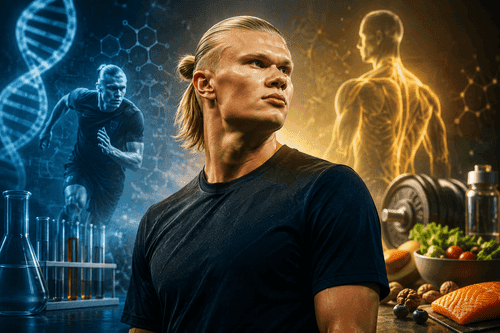
The Haaland Protocol: What Actually Happens When You Optimize a Human Being
Erling Haaland doesn't do anything that a sports scientist from 1995 would find shocking. Sleep more. Eat real food. Track your blood. Get cold on purpose. None of it is secret technology. What's unusual is that he does all of it, every day, with the discipline of someone who treats his own body as a long-term infrastructure project rather than a 25-year-old having fun.
That's the actual story. Not "genetic freak," not "robot." A guy who decided that boredom is a performance strategy.
Here's what's really going on underneath each habit, and why it holds up.
He sleeps like it's his job — because it is
Haaland has talked about treating sleep as non-negotiable, reportedly logging it with a wearable and guarding 9-10 hours most nights. This isn't wellness-influencer padding. Deep sleep is when the pituitary gland releases the bulk of the day's growth hormone, which drives muscle protein synthesis and tissue repair. Slow-wave sleep is also when glycogen stores in muscle get replenished and when the brain clears metabolic waste that builds up during high-intensity exercise.
For a striker specifically, the more interesting number isn't total sleep — it's sleep consistency. Research on elite athletes consistently links irregular sleep timing (not just short sleep) to slower reaction time and worse decision-making under fatigue. A striker's entire value proposition is making the right call in a half-second window inside the box, exhausted, in the 88th minute. That's a cognitive task before it's a physical one, and cognitive performance degrades fast with sleep debt.
The bloodwork-first diet
The detail that separates Haaland from the standard "clean eating" athlete story is that his diet is reportedly built around regular blood panels rather than a fixed meal plan. That's the actual shift in elite sports nutrition over the past decade: moving from generic macros to biomarker-driven personalization. Iron/ferritin, vitamin D, inflammatory markers like CRP, and micronutrient status change week to week based on training load, travel, and even the switch of seasons — and each of those affects mitochondrial energy production and recovery capacity differently.
This is precision nutrition, not discipline theatre. If your ferritin is trending low, more red meat and organ meat gets fed in. If vitamin D dips (a real risk for anyone training indoors through a British winter, ironically the exact opposite problem UAE residents have), supplementation gets adjusted. The diet isn't rigid — it's a feedback loop.
Hypoxic tents and ice baths: stressing the system on purpose
Haaland has used a hypoxic sleeping tent that simulates high altitude — thinner air, lower oxygen. Sleep at simulated altitude and your body responds by producing more erythropoietin (EPO), which increases red blood cell count over time. More red blood cells means more oxygen-carrying capacity, which is a genuine, legal, and heavily used trick in endurance and team sports alike. It's the same underlying mechanism as altitude training camps, just compressed into a bedroom.
Cold exposure works on a different lever. Post-training ice baths cause vasoconstriction, which is thought to reduce the inflammatory swelling and perceived soreness that follows heavy eccentric loading (the kind that comes from repeated sprinting and cutting). The evidence on cold water immersion for long-term muscle adaptation is genuinely mixed — some research suggests overuse can blunt hypertrophy signaling — which is likely why it's used tactically around matches rather than after every single session.
The boring life as a dopamine strategy
Multiple profiles have made a point of how uneventful Haaland's daily routine is by design — limited nightlife, structured days, protected downtime. There's a real neurological argument for this that rarely gets said out loud: high-stimulation environments (constant scrolling, late nights, unpredictable schedules) create dopamine spikes that raise your baseline stimulation threshold, making the actual reward of training and recovery feel comparatively flat. Athletes who report the strongest intrinsic motivation for repetitive, unglamorous training tend to also report deliberately low-stimulation lifestyles outside of it. Discipline isn't just willpower here — it's protecting the reward system that makes discipline sustainable in the first place.
Why it's working, mechanistically
None of these levers are individually dramatic. The compounding is the point. Better sleep improves hormone signaling, which improves recovery, which allows harder training, which the bloodwork monitors to prevent overreaching, which protects against the soft-tissue injuries that quietly end most strikers' primes in their late 20s. It's a closed loop, not a highlight reel.
The rowing boat: when individual optimization meets tribal ritual
Everything above is about Haaland alone — his sleep, his blood, his cold plunges. But the most interesting recent data point about him isn't individual at all. During Norway's World Cup qualifying run, the squad adopted a goal celebration where the scorer and teammates drop into a line and mime rowing a longship, oars in unison, referencing the Viking boats their ancestors crossed the North Sea in. It's become one of the signature images of the campaign.
It's easy to read that as just branding — a nice bit of Norwegian folklore for the highlight reel. But synchronized movement has a real, measurable effect on group physiology that's worth taking seriously. Research on interpersonal motor synchrony (people moving in time together, whether rowing, drumming, or dancing) shows it reliably increases pain threshold and self-reported bonding compared to the same movement done out of sync — an effect attributed to endorphin release triggered by coordinated, effortful motion. Military units, rowing crews, and religious rituals have used synchronized movement to build cohesion for centuries without knowing the mechanism; the mechanism just happens to be endocrine.
There's a genuine tension here that makes Haaland more interesting, not less. He's arguably the most individually optimized player of his generation — bloodwork, hypoxic tents, a diet built around his own biomarkers, none of it shared or standardized for anyone else. And yet the celebration he's most associated with is a piece of pure collective ritual that only works if everyone commits to the same rhythm at the same moment. The personal system makes him capable of scoring the goal. The synchronized ritual is what turns that goal into shared team physiology rather than an individual stat line. Elite performance, at the level Norway is playing at now, seems to need both: a rigorously individualized nervous system and a genuinely synchronized collective one.
That distinction has an obvious echo in group wellness work — the same logic behind why a shared breathing or movement segment in a group session tends to shift a room's collective stress state faster than the same instructions delivered to people one at a time.
Bringing this to the Gulf: same physiology, different climate
The Nordic version of this protocol assumes cold air, long dark winters, and oily cold-water fish as a dietary default — none of which describe Dubai, Riyadh, or Doha. But the underlying physiology transfers completely. Eating Nordic without leaving the region is not about importing salmon, it's about matching the function of each Nordic staple with a regional equivalent.
The fish swap. Herring and mackerel are prized for omega-3 density (EPA/DHA), which supports the same anti-inflammatory pathways Haaland's diet is targeting. Hammour, sea bream, and sardines from the Gulf carry a comparable omega-3 profile and are far more available fresh and unfrozen here — arguably a nutritional upgrade, since fresh outperforms frozen-and-shipped on oxidation of those same fatty acids.
The altitude problem, inverted. Nordic athletes fight for oxygen; Gulf residents fight for thermoregulation. Training in 40°C heat raises core temperature and cardiovascular strain in a way that mimics some of the stress-adaptation logic of hypoxic training — the body upregulates plasma volume and improves heat-shock protein response with repeated heat exposure. The regional equivalent of the altitude tent isn't a machine — it's structured heat acclimatization protocols, which several UAE and Qatari national teams already use formally.
Cold exposure, made accessible. Ice baths are a harder sell in a region where cold itself is the imported luxury, not the default. But the same vasoconstriction effect is achievable with cold-water immersion tanks or even consistently cool (not ice-cold) pool recovery sessions, which are increasingly standard in Dubai's performance clinics and clubs.
Sleep discipline against a late-night culture. This is the honest friction point. Gulf social and work culture often runs later than Northern European norms — dinners at 9pm, gym culture that peaks after 10pm in summer. The Haaland-style consistency doesn't require Nordic bedtimes; it requires a fixed window, whatever it is, protected the same way every night. Consistency of timing matters more than the specific hour.
Bloodwork as the great equalizer. This is the piece that translates most directly and is arguably underused here relative to how much wellness marketing exists in this market. Vitamin D deficiency is paradoxically common in sun-heavy climates because of indoor lifestyles and sun avoidance — the opposite driver from the UK, same clinical outcome. A biomarker-first approach, rather than a borrowed Scandinavian meal plan, is the more honest and more effective translation of what Haaland is actually doing. He's not eating a "Nordic diet." He's eating his own bloodwork, and it happens to be sourced in Norway.
That's the real takeaway for anyone trying to adapt this outside football: the specific foods and tools are geography. The feedback loop — measure, adjust, protect recovery, repeat — is the part that's exportable anywhere.
Sources & further reading
- Sleep and growth hormone / muscle repair: research on slow-wave sleep and pituitary GH pulsatility (sleep endocrinology literature, e.g. work summarized in Van Cauter et al. on sleep and hormonal regulation)
- Sleep consistency and reaction time/decision-making in athletes: chronobiology and sports performance literature on sleep regularity vs. total sleep time
- Altitude/hypoxic exposure and erythropoietin (EPO) response: classic "live high, train low" altitude training research (e.g. Levine & Stray-Gundersen)
- Cold water immersion and inflammation/hypertrophy trade-offs: studies on post-exercise cold water immersion and resistance training adaptation (e.g. Roberts et al., 2015, Journal of Physiology)
- Interpersonal motor synchrony, endorphin release, and pain threshold/bonding: Tarr, Launay & Dunbar, "Silent Disco: Dancing in Synchrony Leads to Elevated Pain Thresholds and Social Closeness," Evolution and Human Behavior (2015)
- Vitamin D deficiency prevalence in sun-rich but indoor-heavy climates: regional public health literature on vitamin D status in Gulf populations
Medically Reviewed By: May Chalhoub, Certified Nutritionist at Valeo Health
Reviewed for medical accuracy, safety guidelines, and healthcare recommendations.