



How To Relieve Yourself From Heartburn
First, let's keep these stats in mind:
- Drugs for acid reflux and GERD are cash cows for pharmaceutical companies.
- In 2006 Americans spent $13 billion on acid suppressing medications.
- The availability of antacids over-the-counter permits patients to self-medicate without reporting their condition to a doctor.
Why do we experience this chronic, painful, and debilitating condition in the developed world?
We’re always told ‘too much acid?’ NO! The incidence of heartburn and GERD increases with age, while stomach acid levels generally decline with age. If heartburn were caused by too much stomach acid, we’d have a bunch of teenagers popping antacids instead of the elderly. But of course, that’s the opposite of what we see. The image below shows the steady decline of the production of stomach acid through the decades. Look at it and decide for yourself if an individual should really be using acid suppressing medication in their 40s, or 50s.
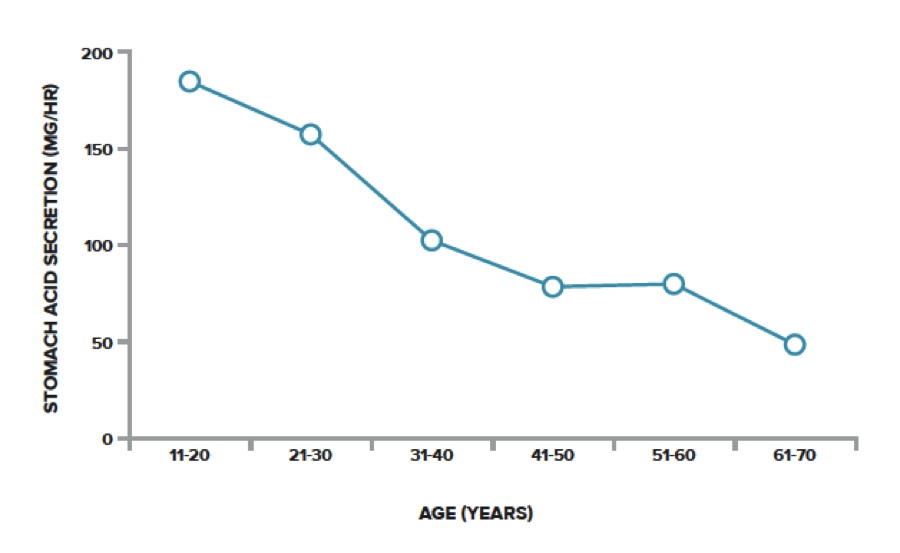
When stomach acid levels are tested in individuals experiencing heartburn and GERD they almost always test low. When those individuals undertake to increase their acid production, the issue is usually resolved.
The Underlying Reasons Behind GERD (Gastroesophageal reflux disease)
GERD is caused by a dysfunction of the muscular valve (sphincter) that separates the lower end of the oesophagus and the stomach. This is known as the lower esophageal valve, or LES. This is caused by an increase in intra-abdominal pressure (IAP). Acid reflux occurs when pressure causes gastric distention (stomach bloating) that pushes the stomach contents, including acid back up through the LES into the oesophagus. The primary causes of this is bacterial overgrowth and maldigestion of carbohydrates – both of which are caused at least in part by low stomach acid. Usually over an extended period. Though microbes can metabolise proteins and even fats, their preferred energy source is carbohydrates. The fermentation of carbohydrates that haven’t been digested properly produces the gas. The resulting gas increases intra-abdominal pressure, which is the driving force behind acid reflux and GERD.
If this is all true, then why do antacid medications appear to work?
Any amount of acid in the oesophagus will cause a great deal of discomfort. Antacid medications will usually successfully suppress those symptoms for a short amount of time. However, given that the underlying cause is low acid, they will do nothing but continue the cycle and contribute to the underlying cause.
When stomach acid is sufficient and carbohydrates are consumed in moderation, they are properly broken down into glucose and rapidly absorbed in the small intestine before they can be fermented by microbes. However, if stomach acid is insufficient and/or carbohydrates are consumed in excess, some of the carbs will escape absorption and become available for intestinal microbes to ferment and repeat the cycle all over again.
The Solution
When stomach acid is sufficient and carbohydrates are consumed in moderation, they are properly broken down into glucose and rapidly absorbed in the small intestine before they can be fermented by microbes. However, if stomach acid is insufficient and/or carbohydrates are consumed in excess, some of the carbs will escape absorption and become available for intestinal microbes to ferment.
- Reduce factors that promote bacterial overgrowth and low stomach acid.
- Replace stomach acid, enzymes and nutrients that aid digestion and are necessary for health.
- Restore beneficial bacteria and a healthy mucosal lining in the gut.
- And ofcourse, speak to your Valeo expert.