



Breastfeeding Positions Explained: What Works Best and Why
Breastfeeding is one of the most important aspects of newborn care, providing essential nutrients, antibodies, and comfort. However, for many new parents, finding the right breastfeeding positions can feel overwhelming at first. The way you hold your baby during feeding not only affects comfort but also impacts milk flow, latch, and your baby’s overall feeding experience. Choosing the right position can make breastfeeding easier, prevent nipple pain, and ensure your newborn is getting the nutrition they need.
In this article, we will explain the most effective breastfeeding positions for newborns, why they work, and how to use them for a successful feeding experience.
Why Breastfeeding Positions Matter
Correct breastfeeding positions are critical for both mother and baby. Improper positioning can lead to problems such as:
- Sore nipples and breast pain
- Inefficient milk transfer
- Gassiness or fussiness in the newborn
- Early weaning due to discomfort
The goal is to find a position that supports your baby’s head, neck, and body alignment while allowing full access to the breast. Proper positioning also reduces strain on the mother’s back, shoulders, and arms, making the experience more comfortable and sustainable.
Common Breastfeeding Positions for Newborns
There are several tried-and-true positions that work well for most mothers and babies. Each position offers unique benefits depending on the mother’s comfort, the baby’s size, and any medical considerations.
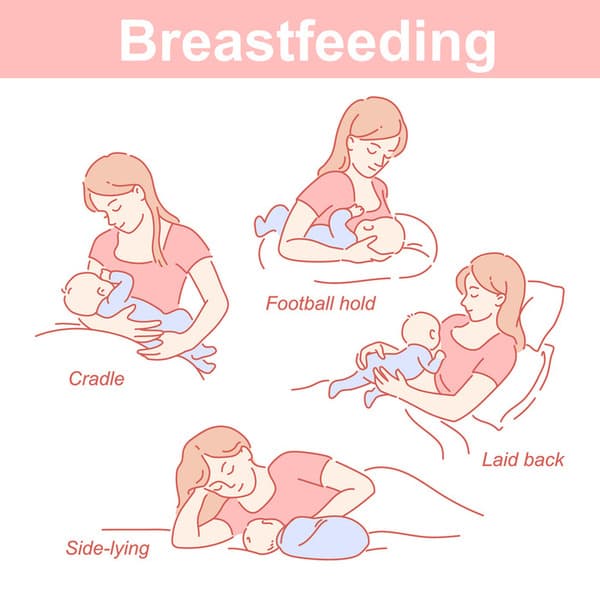
1. Cradle Hold
The cradle hold is one of the most popular breastfeeding positions for newborns. In this position, the baby’s head rests in the crook of the mother’s arm on the same side as the breast being used, while the baby’s body faces the mother with their chest and abdomen aligned.
Benefits:
- Provides excellent head support
- Encourages eye contact and bonding
- Easy for mothers with older newborns or smaller babies
Tips:
Make sure your baby’s nose is level with your nipple and their body is aligned straight to avoid twisting the neck.
2. Cross-Cradle Hold
The cross-cradle hold is similar to the cradle hold but offers more control over the baby’s head. In this position, the mother supports the baby with the arm opposite the breast being used, while the other hand supports the breast.
Benefits:
- Ideal for newborns learning to latch
- Gives better control when guiding the baby to the breast
- Suitable for premature or smaller babies
Tips:
Support your baby’s neck and shoulders, not just the head, to maintain a proper latch.
3. Football or Clutch Hold
In the football (or clutch) hold, the baby is positioned at the mother’s side, tucked under her arm like a football, with their legs pointing toward the back of the chair and their head supported near the breast.
Benefits:
- Reduces pressure on the mother’s abdomen
- Great for mothers who had a C-section
- Provides a clear view of the latch for first-time parents
Tips:
Use a pillow to support the baby’s body for comfort and stability.
4. Side-Lying Position
The side-lying position is perfect for nighttime feeds or mothers recovering from delivery. Both mother and baby lie on their sides facing each other.
Benefits:
- Reduces strain on the mother’s back and arms
- Convenient for nighttime feeds
- Helpful for mothers recovering from delivery or a C-section
- Comfortable for long or frequent feeding sessions
Tips:
Ensure the baby’s head and body are aligned and close enough to the breast for an effective latch.
5. Laid-Back or Reclined Position
In the laid-back position, the mother reclines comfortably while the baby lies on her chest, tummy to tummy. Gravity helps the baby latch naturally.
Benefits:
- Encourages natural rooting and self-latching
- Reduces nipple pain for the mother
- Can help babies with reflux or fast milk flow
Tips:
Use pillows or cushions to support your back and arms, keeping the baby secure.
Tips for Successful Breastfeeding Positions
To make any breastfeeding position more effective for your newborn:
- Keep the baby’s head, neck, and body aligned
- Make sure the baby’s mouth covers most of the areola, not just the nipple
- Use pillows to support your back, arms, or baby
- Switch positions if you feel discomfort or the baby is fussy
- Consult a lactation specialist if you experience ongoing pain or latching issues
Final Thoughts
Finding the right breastfeeding positions can take time and practice. Every mother and baby are different, so what works best for one may not work for another. Experimenting with positions like cradle hold, cross-cradle, football hold, side-lying, or laid-back can make breastfeeding easier, more comfortable, and more enjoyable for both mother and newborn.
By understanding and using proper breastfeeding positions as a newborn, mothers can ensure their babies get the nutrition they need while reducing discomfort and creating a positive bonding experience.
For mothers in Dubai seeking professional guidance, Valeo Health provides expert support through their Postpartum Wellness Program. Experienced lactation specialists Shaymaa Badreddine can guide you through the best breastfeeding positions, offer tips for a smoother feeding experience, and ensure both you and your baby stay healthy and comfortable.