

What to Avoid When Taking Collagen in Kuwait: Side Effects, Mistakes & Who Should Be Careful
Collagen is generally considered a well-tolerated dietary supplement, which can make it easy to assume there is nothing to think about once you buy a tub.
In reality, most problems with collagen are not dramatic side effects. They are simpler mistakes: taking an unsuitable product for your allergies, expecting results too quickly, stacking several beauty supplements with overlapping ingredients or relying on collagen while ignoring the lifestyle factors that affect skin far more strongly.
Understanding what to avoid when taking collagen can therefore make your routine safer, simpler and less wasteful.
This is particularly relevant in Kuwait, where frequent sun exposure makes skin protection an important part of any routine focused on maintaining healthy-looking skin.
This guide covers realistic collagen side effects, habits that may work against your goals, who should check with a healthcare professional first and how to choose a sensible routine without turning your supplement shelf into a chemistry experiment.
Quick Answer: What Should You Avoid When Taking Collagen?
The main things to avoid are:
relying on collagen instead of daily sun protection
taking several collagen products without checking their combined ingredients
counting collagen as your main source of dietary protein
constantly changing products before giving a routine enough time
ignoring the actual amount of collagen per serving
using marine collagen if you have a fish allergy
assuming that more collagen automatically means better results
overlooking existing kidney conditions or a history of calcium-oxalate kidney stones
Most healthy adults tolerate collagen well, but the source, serving size, additional ingredients and your individual health history still matter.
The Biggest Mistakes to Avoid When Taking Collagen
Skipping Sun Protection Because You Take Collagen
If your main reason for taking collagen is skin wellness, sunscreen should not disappear from the conversation.
Ultraviolet radiation contributes to photoaging and affects collagen within the skin. No oral beauty supplement should be treated as a replacement for appropriate sun protection.
That matters particularly in Kuwait, where strong year-round sun exposure can be substantial.
A sensible skin routine starts with protecting the collagen you already have. A supplement, if you choose to use one, sits alongside those habits rather than replacing them.
Stopping After Two or Three Weeks
Collagen is not an instant-result supplement.
Many clinical studies evaluating skin hydration and elasticity measure outcomes over roughly 8 to 12 weeks rather than a few days.
That does not mean everyone will notice a visible difference after exactly eight weeks. It means judging a supplement after one or two weeks is usually too early to tell you much.
Hair and nails can take even longer to show visible changes because both grow gradually.
Constantly Switching Between Collagen Products
Changing from one collagen powder to another every couple of weeks makes it difficult to judge any routine properly.
One product may provide 3 grams per serving, another 8 grams and another a completely different blend.
Instead of repeatedly switching based on packaging or advertising, compare the formulas carefully and choose a product that fits your needs and daily routine.
Consistency makes the experiment much easier to evaluate.
Ignoring the Amount of Collagen Per Serving
The size of the scoop is not necessarily the amount of collagen you receive.
A 10-gram scoop may contain 10 grams of collagen peptides, or it may contain a smaller quantity of collagen alongside flavouring, sweeteners, vitamins or other ingredients.
Read the nutrition and ingredient panels.
Look specifically for the grams of collagen or collagen peptides supplied per serving.
This is especially important when comparing flavoured and unflavoured products.
Counting Collagen as Your Main Protein Source
Collagen is a protein, but it is not a complete protein.
Its amino-acid profile is different from complete dietary proteins such as eggs, dairy, fish, meat or appropriately combined plant proteins.
Collagen should therefore not replace the protein you obtain from a balanced diet.
Adequate overall protein intake remains important whether or not you use a collagen supplement.
Should You Avoid Taking More Than One Collagen Product?
You generally do not need several collagen products at the same time.
For example, someone may unknowingly take a collagen powder in the morning, collagen gummies later in the day and a beauty supplement containing additional collagen in the evening.
That may increase cost and duplicate other ingredients such as biotin, zinc or vitamin C without a clear reason.
Before stacking products, compare their complete labels.
The goal should be a clear routine, not the largest possible number of supplements.
Do You Need High-Dose Vitamin C With Collagen?
Vitamin C is required for normal collagen synthesis in the body, but that does not mean more is always better.
A balanced diet can provide vitamin C, and some collagen formulas already include it.
If your collagen product contains vitamin C and you also take a multivitamin or another fortified supplement, check the combined intake before adding a separate high-dose product.
Avoid unnecessary duplication rather than assuming a megadose will make collagen work faster.
Can You Put Collagen in Hot Coffee?
Yes, you generally do not need to avoid mixing hydrolysed collagen peptides into normal hot drinks.
Hydrolysed collagen has already been processed into smaller peptide fragments.
Adding it to coffee, tea or another normal-temperature hot beverage is a practical way for some people to make supplementation part of a consistent routine.
What matters more is following the product directions and choosing a method you can maintain.
Do You Need to Take Collagen on an Empty Stomach?
No.
There is no general requirement that collagen be taken on an empty stomach.
You can take it with food or incorporate it into a drink or meal.
If taking a supplement without food makes you feel nauseated or uncomfortable, using it alongside a meal may be easier.
The best timing is usually the timing that makes your routine consistent.
What Are the Most Common Collagen Side Effects?
Collagen side effects are usually mild when they occur.
Feeling Full
Because collagen contributes protein, larger servings may make some people feel fuller than expected.
This may be useful to know if you take it immediately before a meal.
Bloating or Digestive Discomfort
Some people experience bloating, heaviness, nausea or changes in bowel habits.
The response may depend on the serving size, the product itself and additional ingredients such as sweeteners or flavourings.
If symptoms are persistent or significant, stop using the product and seek medical advice.
Aftertaste
Unflavoured marine collagen can have a characteristic taste or smell.
However, an extremely strong or unpleasant fishy smell is worth checking with the manufacturer, particularly if the product seems damaged or has been stored incorrectly.
Allergic Reactions
The most important source-specific risk is allergy.
Marine collagen comes from fish-derived materials.
Anyone with a fish allergy should not assume a marine collagen product is safe simply because it is sold as a supplement.
Stop using a product and seek urgent medical attention if you experience symptoms such as facial swelling, breathing difficulty or another severe allergic reaction.
Who Should Be Careful With Collagen Supplements?
People With Fish Allergies
If you have a fish allergy, marine collagen may not be appropriate.
Read the allergen statement carefully and consider a different collagen source only after confirming that it is suitable for you.
People With Kidney Disease
People with kidney disease may have individual protein, mineral or fluid recommendations.
Collagen contributes to total protein intake, so anyone with impaired kidney function or a medically prescribed protein restriction should discuss supplementation with their healthcare professional first.
People With a History of Calcium-Oxalate Kidney Stones
Collagen is rich in the amino acid hydroxyproline.
Hydroxyproline metabolism can contribute to urinary oxalate production.
That does not mean normal collagen supplementation has been proven to cause kidney stones in healthy people.
However, someone with recurrent calcium-oxalate stones or a known stone disorder should discuss collagen supplementation with their clinician before starting.
People Following a Protein-Restricted Diet
Collagen contributes to daily protein intake.
If you have been advised to limit protein for medical reasons, include collagen when discussing your overall intake with your doctor or dietitian.
Pregnancy and Breastfeeding
Collagen itself is a protein, but dedicated safety evidence for many commercial collagen supplements during pregnancy and breastfeeding is limited.
Products may also contain vitamins, herbs, sweeteners or other active ingredients beyond collagen.
For that reason, check with your healthcare professional before using a supplement during pregnancy or breastfeeding.
People Taking Prescription Medication
Plain collagen peptides are not known for a long list of major direct medication interactions.
However, many commercial collagen products contain additional ingredients.
If you take prescription medication, review the complete label rather than checking collagen alone, and ask a pharmacist or doctor when necessary.
Is Vegan Collagen Really Collagen?
No true plant-derived collagen exists.
Collagen is an animal structural protein.
Products marketed as vegan collagen are usually better described as collagen-support or collagen-builder formulas.
They may contain nutrients such as vitamin C, zinc, silica, biotin or amino acids intended to support the body's normal collagen-production processes.
That does not make them inherently bad products.
It simply means they should not be compared gram-for-gram with hydrolysed animal collagen peptides.
How to Choose a Collagen Supplement in Kuwait Without Wasting Money
Once you understand the safety basics, choosing a collagen supplement in Kuwait becomes much easier.
Look at the source first.
Then check whether the collagen is hydrolysed, how many grams are supplied in each serving, how many servings the container provides and whether there are additional ingredients you actually want.
Allergen information should be easy to find.
If certification matters to you, verify the certification rather than assuming it from the raw-material source.
Finally, think about format.
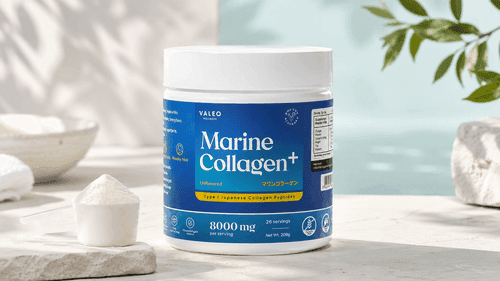
If you regularly drink coffee, smoothies or juice, the Valeo Health Marine Collagen+ supplement in Kuwait for an unflavoured daily routine may fit naturally into something you already do.
If you prefer mixing your supplement directly into water, the Valeo Health mango-flavoured marine collagen supplement in Kuwait offers a different format.
Choosing the format you will actually use is more useful than buying the product with the most dramatic claims.
Can You Combine Collagen With Glutathione?
Collagen and glutathione are different compounds.
Collagen supplies a particular amino-acid and peptide profile, whereas glutathione is an antioxidant involved in different biological processes.
If you are building a wider beauty-focused routine, you could evaluate the Valeo Health glutathione supplement for skin wellness in Kuwait separately according to your goals.
Do not assume that taking several beauty supplements together automatically produces better results.
Can You Take Collagen With a Hair Supplement?
You can, but check for overlapping ingredients first.
Some hair formulas already contain collagen alongside vitamins, minerals or other nutrients.
Before adding several products, compare their labels so you know what you are taking in total.
If hair wellness is one of your separate goals, you can compare your existing routine with the Valeo Health Hair+ supplement with marine collagen in Kuwait before deciding whether another product is necessary.
Can Collagen and Omega-3 Be Taken Together?
They are different supplement categories and there is no general requirement to separate them.
Collagen provides protein-derived peptides, whereas omega-3 supplements provide fatty acids.
If omega-3 intake is part of your separate nutritional goals, the Valeo Health omega-3 supplement for everyday wellness in Kuwait can be evaluated independently from your collagen routine.
The important principle is to give every supplement a clear purpose.
What Actually Helps You Get More From a Collagen Routine?
After looking at what to avoid when taking collagen, the useful habits are relatively simple.
Choose a product with a clearly stated collagen amount.
Use it consistently according to its directions.
Maintain adequate dietary protein.
Get enough vitamin C through your overall diet.
Protect your skin from excessive UV exposure.
Avoid smoking.
Stay adequately hydrated.
Give the routine enough time before deciding whether it fits your goals.
And choose a format you genuinely enjoy enough to keep using.
Why Might Your Collagen Routine Not Be Giving You the Result You Expected?
There are several possibilities.
You may not have used it long enough.
The product may provide less collagen per serving than you assumed.
You may be switching between formulas too often.
Your expectations may be higher than the evidence supports.
Or lifestyle factors such as sun exposure, smoking, inadequate nutrition or poor sleep may be working against your skin-related goals.
It is also possible that you simply do not notice a meaningful change.
Supplements do not produce identical results for everyone.
Final Thoughts
The most useful answer to what to avoid when taking collagen is surprisingly practical.
Do not treat collagen as a substitute for sun protection or adequate nutrition. Do not count it as your primary protein source. Do not stack multiple formulas without reading the labels, and do not assume every marine product is suitable if you have a fish allergy.
Most collagen side effects are mild, but existing kidney disease, medical protein restrictions, pregnancy, breastfeeding and a history of calcium-oxalate stones are good reasons to seek individual advice.
If you are comparing marine collagen in Kuwait, look at the source, allergen information, grams per serving and complete formulation.
And when choosing a collagen supplement in Kuwait, remember that a simple product you can use consistently is often more practical than the most complicated formula on the shelf.
Medically Reviewed By: Dr. Rayan Mohammed, General Practitioner at Valeo HealthReviewed for medical accuracy, safety guidelines, and healthcare recommendations.