

Vitamin D Tablets in Kuwait: Dosage, 50,000 IU, D3 vs D2 and K2
Vitamin D comes in an unusually wide range of strengths. One shelf may contain a low-dose everyday supplement and a 50,000 IU capsule intended for medically managed deficiency.
That difference creates understandable confusion.
Choosing vitamin D tablets is not simply about finding the largest number on the label. The appropriate amount depends on age, diet, medical history, whether deficiency has actually been diagnosed, and whether the dose is intended for general intake or medical correction.
This Kuwait guide explains the difference between everyday vitamin D intake and high-dose treatment, what the 50,000 IU capsule is actually for, how D3 compares with D2, why K2 is often paired with vitamin D and how to take a supplement sensibly.
Quick Answer: How Much Vitamin D Should You Take?
For generally healthy adults, more is not automatically better.
Current guidance recommends that most healthy adults under 75 obtain the established recommended dietary intake rather than routinely taking doses above it simply for disease prevention. The reference intake is generally 600 IU or 15 µg daily for adults through age 70 and 800 IU or 20 µg after age 70.
The adult tolerable upper intake level is 4,000 IU or 100 µg per day. That is a safety ceiling for unsupervised long-term intake, not a target everyone should aim for.
People with diagnosed deficiency, malabsorption or another clinical indication may be given a different vitamin D dosage by their healthcare professional.
Maintenance Intake and Deficiency Treatment Are Different
One of the biggest sources of confusion is treating everyday supplementation and medical treatment as the same thing.
An everyday intake is intended to help meet nutritional requirements.
A correction regimen is different. It is used when a healthcare professional has identified a reason to treat deficiency and may involve substantially larger amounts for a limited period.
That is why selecting vitamin D tablets based only on what somebody else takes can be misleading.
Healthy adults also do not automatically need routine 25(OH)D screening. Testing becomes more relevant when there is an established clinical reason, symptoms, risk factors or a healthcare professional needs the result to guide treatment.
Vitamin D Dosage: Why 4,000 IU Is Not the Default
The phrase vitamin D dosage often leads people directly to numbers such as 1,000, 2,000 or 4,000 IU.
But the number should be interpreted correctly.
For adults, 4,000 IU per day is the established tolerable upper intake level from all sources for routine intake. It should not be interpreted as the amount every adult needs.
A clinician may recommend a dose above this limit temporarily when treating an established deficiency, but that is different from self-supplementation.
Vitamin D is fat-soluble, so excessive intake can accumulate. Very high intake over time may cause excessive calcium levels, with symptoms including nausea, weakness, excessive thirst, frequent urination and, in serious cases, kidney complications.
What Is Vitamin D 50000 IU Used For?
Vitamin D 50000 IU belongs in a completely different category from an everyday low-dose supplement.
Some clinician-directed deficiency-treatment protocols have used 50,000 IU of vitamin D once weekly for a limited period, such as around eight weeks, before reassessment and transition to an appropriate ongoing dose.
This does not mean everyone with a low result needs the same regimen.
The exact dose, treatment duration and need for repeat testing should follow the prescriber's advice and local Kuwait clinical practice.
Vitamin D 50000 IU is:
Not intended to be taken every day
- Not a routine wellness dose
- Not something to continue indefinitely without medical guidance
- Not a substitute for interpreting why vitamin D is low
Taking 50,000 IU daily instead of weekly could expose someone to extremely excessive intake.
Vitamin D3 vs D2: Which Form Should You Choose?
Vitamin D3 vs D2 is another common question when comparing supplement labels.
Vitamin D3 is cholecalciferol. It is the form produced naturally in human skin after UVB exposure.
Vitamin D2 is ergocalciferol and is traditionally obtained from fungi or plant-related sources.
Both can raise vitamin D status, but comparative studies and meta-analyses generally find D3 more effective at raising total circulating 25(OH)D.
For many people, D3 is therefore a practical supplement choice.
People following a vegan diet should still check the source because conventional D3 may be animal-derived, although vegan D3 from lichen is available.
When comparing vitamin D3 vs D2, look beyond the front of the bottle and check the actual form and strength listed on the supplement facts panel.
Why Are Vitamin D and K2 Often Combined?
Vitamin D and K2 frequently appear together in modern supplement formulas.
Vitamin D contributes to calcium absorption and normal bone health. Vitamin K is required for the normal function of vitamin-K-dependent proteins involved in blood clotting and bone biology.
This provides a biological rationale for combining the nutrients, but it does not mean everybody who takes vitamin D automatically requires a K2 supplement.
The long-term clinical evidence for using the combination specifically to prevent cardiovascular or fracture outcomes in the general population is still developing.
The most important safety consideration is medication.
Vitamin K can interact significantly with warfarin and related vitamin K antagonist medicines. People taking these medications should not add a K-containing supplement without discussing it with their healthcare professional.
When Should You Take Vitamin D?
When to take vitamin D is simpler than many supplement routines make it sound.
There is no universally required morning or evening time.
Consistency matters more.
Because vitamin D is fat-soluble, taking it with a meal containing some fat is practical. A controlled study found vitamin D3 absorption was greater when the dose was consumed with a fat-containing meal than with a fat-free meal.
That meal might contain eggs, avocado, nuts, olive oil, yoghurt or fish.
Taking vitamin D without food does not mean the entire dose is “wasted,” but taking it with a meal can support absorption.
So when to take vitamin D usually comes down to choosing a meal you reliably eat each day.
What About Magnesium and Vitamin D?
Magnesium participates in numerous enzymatic reactions, including pathways involved in vitamin D metabolism.
That does not mean everyone using vitamin D needs an additional magnesium supplement.
Start by considering your overall diet and individual requirements.
If magnesium intake is something you are addressing separately, you can compare the Valeo Health Magnesium+ supplement in Kuwait for daily mineral support with the rest of your routine.
The aim is to fill a genuine nutritional need rather than automatically stack supplements.
How to Choose Vitamin D Supplements in Kuwait
When comparing vitamin D tablets, read the complete label rather than choosing by dose alone.
Check:
- Whether the form is D3 or D2
- The amount in both IU and micrograms
- The recommended serving
- Whether K2 is included
- Whether K2 is clearly identified
- Other vitamins or minerals in the formula
- Your total vitamin D intake from all supplements
- The expiry date and storage instructions
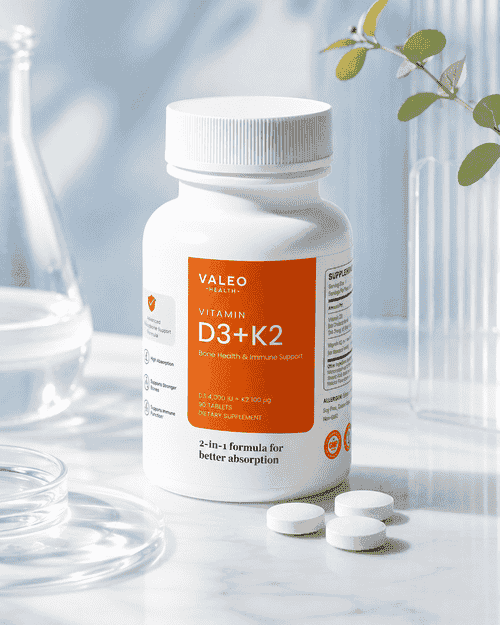
For people comparing options locally, the Valeo Health vitamin D in Kuwait includes vitamin D3 + K2 alongside other daily wellness supplements. Valeo's Kuwait catalogue currently also lists Magnesium+ and Super Omega+ as part of its supplement range.
Do not assume a combination formula is automatically better. It should still match your individual requirements.
Can Omega-3 Be Taken With Vitamin D?
Vitamin D and omega-3 are different nutrients and have different roles.
You do not need an omega-3 supplement specifically in order to use vitamin D.
However, both can be taken as part of the same broader nutrition routine when individually appropriate.
If omega-3 intake is one of your separate nutritional goals, the Valeo Health for daily omega-3 support can be considered independently from your vitamin D routine.
Give every supplement a clear reason for being there.
How Should Vitamin D Be Stored in Kuwait?
Kuwait's climate makes supplement storage worth thinking about.
Avoid leaving supplements in a parked car, beside a sunny window or anywhere exposed to extreme heat.
Keep the product according to its label instructions in a dry, temperature-appropriate environment.
Purchasing supplements from a supplier that stores and transports products appropriately is particularly important during hot months.
Who Should Take Extra Care With Vitamin D?
Speak with a healthcare professional before self-prescribing high-dose vitamin D if you:
- Have kidney disease
- Have high blood calcium
- Have hyperparathyroidism or certain granulomatous conditions
- Take thiazide diuretics or other medicines affecting calcium or vitamin D
- Are pregnant or breastfeeding
- Are considering more than 4,000 IU per day
- Are giving vitamin D to a child or infant
If your product contains K2, additional caution is necessary when taking warfarin or another vitamin K antagonist.
Final Thoughts
Choosing vitamin D tablets should begin with understanding why you are taking them.
Do not treat the 4,000 IU upper limit as an everyday target, and do not treat a 50,000 IU prescription capsule as a normal supplement.
The right vitamin D dosage depends on whether the goal is simply meeting nutritional requirements or treating a clinically identified problem.
Understand the form, check the dose, take it consistently and use high-dose treatment only under appropriate medical supervision.
Medical Discalaimer
Medically Reviewed By: Dr. Rayan Mohammed, General Practitioner at Valeo Health
Reviewed for medical accuracy, safety guidelines, and healthcare recommendations.