
Vitamin D Deficiency Symptoms in Kuwait: Signs, Causes, Testing and What to Do
Kuwait has intense sunshine for much of the year, so vitamin D deficiency can sound almost contradictory.
Yet plenty of sunshine does not automatically mean plenty of vitamin D.
Daily life in Kuwait often means moving between air-conditioned homes, offices, malls and cars, while avoiding the strongest midday heat. Clothing coverage, limited time outdoors, skin pigmentation and other individual factors can further reduce the amount of UVB radiation reaching the skin.
The result is that vitamin D deficiency symptoms can still appear even in one of the sunniest parts of the world.
The difficult part is that the symptoms are rarely dramatic. Fatigue, muscle aches, low mood or feeling generally run-down can easily be blamed on work, poor sleep or stress.
This guide explains the signs worth noticing, why vitamin D deficiency in Kuwait is possible despite abundant sunshine, what a blood test actually measures, what else can cause similar symptoms and what to consider before starting a supplement.
Quick Answer: What Are the Main Vitamin D Deficiency Symptoms?
Common vitamin D deficiency symptoms can include persistent tiredness, muscle weakness or aching, bone discomfort, lower-back pain and, in more pronounced deficiency, problems related to bone mineralisation.
Some people also report low mood or hair thinning, although both have many possible causes and should not automatically be attributed to vitamin D.
The important point is that these symptoms are non-specific.
One symptom by itself tells you very little. A pattern of persistent symptoms combined with relevant risk factors is more meaningful and may justify discussing vitamin D status with a healthcare professional.
When vitamin D status needs to be assessed, the standard blood marker is 25-hydroxyvitamin D, usually written 25(OH)D.
Why Is Vitamin D Deficiency Common in Kuwait Despite All the Sunshine?
Vitamin D production in the skin depends on UVB radiation reaching exposed skin.
Kuwait has plenty of UVB, but everyday behaviour can substantially reduce actual exposure.
Most People Avoid the Strongest Sun
From late spring through summer, spending long periods outdoors around midday is uncomfortable and may increase the risk of heat-related illness and skin damage.
Naturally, many people spend the hottest part of the day indoors.
Glass Does Not Give You Meaningful UVB Exposure
A bright office or car may feel sunny, but standard window glass blocks most UVB radiation.
Sitting next to a sunny window is therefore not equivalent to spending time outdoors.
Clothing Reduces the Amount of Skin Exposed
Both cultural clothing and practical sun-protective clothing can reduce the amount of skin exposed to UVB.
That does not mean people should change appropriate clothing simply to increase vitamin D.
It simply helps explain vitamin D deficiency in Kuwait despite the climate.
Darker Skin Produces Vitamin D More Slowly From the Same UV Exposure
Melanin acts as a natural filter of ultraviolet radiation.
People with more deeply pigmented skin generally require greater UVB exposure to produce an equivalent amount of vitamin D compared with lighter skin.
Indoor Work Limits Exposure
Many people are indoors during the part of the day when UVB is most available.
Commuting by car and moving through covered parking can reduce outdoor exposure even further.
These factors help explain why sunny weather alone cannot be used to predict an individual's vitamin D level.
Vitamin D Deficiency Symptoms Worth Paying Attention To
The symptoms of low vitamin D often develop gradually.
That makes them easy to ignore or explain away.
Fatigue That Does Not Improve With Rest
Persistent tiredness is one of the most commonly discussed symptoms.
However, fatigue is extremely non-specific.
Poor sleep, iron deficiency, thyroid problems, vitamin B12 deficiency, chronic stress, depression, sleep apnoea and blood sugar problems can all cause similar symptoms.
Vitamin D should therefore be considered as one possibility rather than the automatic explanation.
Muscle Weakness
Vitamin D plays an established role in normal muscle function.
More significant deficiency may be associated with muscle weakness, especially around larger muscle groups such as the hips and thighs.
You may notice that stairs, getting up from a low chair or familiar physical activity feels more difficult than usual.
Muscle Aches
General muscle discomfort can occur for many reasons, including training, poor recovery, medications, electrolyte issues and other health conditions.
If aching persists alongside other vitamin D deficiency symptoms, it may be worth discussing with a healthcare professional.
Bone Pain and Lower-Back Discomfort
Severe, prolonged vitamin D deficiency can interfere with bone mineralisation.
In adults, significant deficiency can contribute to osteomalacia, which may cause diffuse bone pain or tenderness.
Persistent back, hip, pelvic or bone pain should be medically evaluated rather than self-treated with supplements.
Low Mood
Research has found associations between low vitamin D levels and mood symptoms, but association does not prove that low vitamin D is the direct cause.
Low mood and low vitamin D may also share common factors such as reduced time outdoors.
If low mood persists or affects daily functioning, appropriate mental-health assessment is more important than assuming a supplement will solve it.
Hair Thinning
Low vitamin D has been associated with some forms of hair loss, but hair thinning has many possible explanations.
Iron deficiency, thyroid disorders, hormonal factors, stress, genetics and nutritional deficiencies can all contribute.
Hair loss should therefore be investigated rather than automatically treated with vitamin D.
Frequent Illness
Vitamin D has recognised roles in normal immune function.
However, frequently catching infections is not specific enough to diagnose deficiency.
Sleep, stress, underlying health conditions, exposure patterns and other nutritional factors can also influence how often you become unwell.
Which Pattern of Symptoms Matters Most?
One vague symptom is rarely enough to point toward vitamin D.
The pattern becomes more relevant when several symptoms occur together and persist over time.
For example:
ongoing fatigue
muscle weakness or aching
bone discomfort
limited outdoor exposure
darker skin pigmentation
older age
malabsorption
certain medicines
previous low vitamin D results
A combination like this gives a healthcare professional more reason to consider vitamin D than tiredness alone.
Who Is More Likely to Have Low Vitamin D?
Several groups have a greater likelihood of low vitamin D status.
These include people who spend most daylight hours indoors, people with limited exposed skin outdoors, people with darker skin, older adults and people with conditions that reduce nutrient absorption.
People with obesity can also have lower circulating vitamin D concentrations.
Certain medications can affect vitamin D metabolism.
People who have undergone bariatric surgery or who live with malabsorption disorders such as coeliac disease or Crohn's disease may also require individual assessment.
Pregnancy, breastfeeding and infancy have their own nutritional considerations and should be managed according to professional guidance.
What Does a Vitamin D Blood Test Measure?
When vitamin D status needs to be assessed, the test used is 25-hydroxyvitamin D or 25(OH)D.
This is the main circulating form used to evaluate vitamin D status.
Results may be reported in either nmol/L or ng/mL, so always check the unit rather than comparing numbers from two different reports directly.
Broadly, commonly used reference points are:
below 30 nmol/L, or below 12 ng/mL: associated with vitamin D deficiency
30 to below 50 nmol/L, or 12 to below 20 ng/mL: generally considered inadequate
50 nmol/L, or 20 ng/mL and above: adequate for most healthy people
Different laboratories and clinical situations may use different reference ranges.
A result should therefore be interpreted in the context of your symptoms, health history and laboratory report rather than as an isolated number.
Should Everyone in Kuwait Get a Vitamin D Blood Test?
Not necessarily.
Routine vitamin D screening is not recommended for every otherwise healthy adult.
However, testing can be useful when there is a clinical reason to suspect deficiency, when symptoms and risk factors fit the picture, or when a healthcare professional needs a level to guide treatment.
If you have persistent symptoms rather than simply wanting to guess from how you feel, asking a healthcare professional whether a vitamin D blood test in Kuwait is appropriate is more useful than starting very high-dose supplementation on your own.
When Fatigue May Not Be Caused by Vitamin D
Fatigue is one of the main reasons people begin searching for vitamin D deficiency symptoms.
It is also one of the least specific symptoms in healthcare.
Several other common conditions can feel almost identical.
Iron Deficiency
Iron deficiency may cause tiredness, low energy, headaches, dizziness, shortness of breath, hair shedding and reduced exercise tolerance.
It is particularly worth considering in people who menstruate or have increased iron requirements.
If testing confirms low iron and a healthcare professional recommends supplementation, you can explore Valeo Health iron supplements for daily nutritional support in Kuwait rather than taking iron simply because you feel tired.
Thyroid Dysfunction
Thyroid conditions can produce fatigue, low mood, weight changes, temperature sensitivity and changes in hair.
That symptom overlap is one reason persistent fatigue deserves proper assessment.
Vitamin B12 Deficiency
Vitamin B12 deficiency can cause fatigue and neurological symptoms and may be more relevant in some people following vegetarian or vegan diets or people with absorption problems.
Poor Sleep or Sleep Apnoea
Sleeping for enough hours does not always mean sleep quality is adequate.
Snoring, repeated waking or untreated sleep apnoea can leave someone tired every morning despite spending eight hours in bed.
Blood Sugar Problems
Changes in glucose regulation can contribute to fatigue and changes in energy.
Again, vitamin D should not become the default explanation for every episode of tiredness.
How Is Low Vitamin D Addressed?
The appropriate approach depends on why the level is low and how low it is.
There are three main sources of vitamin D: sunlight, food and supplementation.
Can You Correct Vitamin D With Sunlight in Kuwait?
Skin can produce vitamin D after UVB exposure, but advising people simply to “get more sun” is not always practical or safe in Kuwait.
Excessive ultraviolet exposure increases skin-damage risk.
Vitamin D is not a reason to deliberately burn or spend unsafe periods outside during extreme heat.
A balanced approach to sunlight, appropriate sun protection and individual nutritional needs makes more sense than trying to correct a confirmed deficiency through uncontrolled sun exposure.
Which Foods Contain Vitamin D?
Vitamin D is found naturally in relatively few foods.
Useful dietary sources include oily fish such as salmon, sardines and mackerel, along with egg yolks and some fortified foods.
Food contributes to overall intake, but someone with a confirmed deficiency may need more than diet alone.
The appropriate plan depends on the blood result and clinical situation.
Choosing a Vitamin D Supplement in Kuwait
If supplementation is appropriate, the most important question is not which bottle looks best.
Start with the amount of vitamin D provided in each serving.
Check whether the product contains vitamin D3 or another form, what other ingredients are included and how the serving fits with any other supplements you already use.
Avoid combining several products containing vitamin D without calculating your total intake.
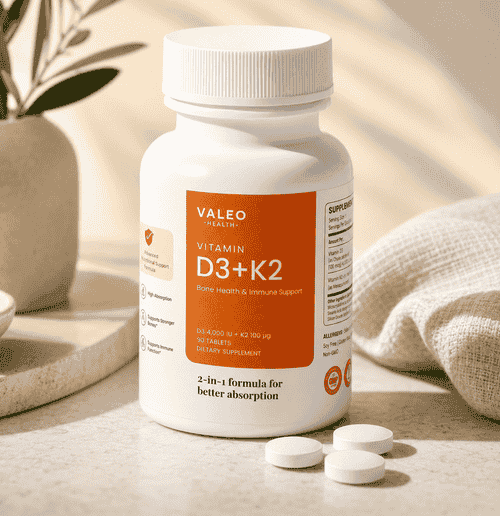
For people looking for a vitamin D supplement in Kuwait, you can explore the Valeo Health Vitamin D supplement in Kuwait for daily wellness support, including formulas that combine Vitamin D3 with K2.
The right dose for correcting an established deficiency can be different from a general maintenance intake, so avoid selecting a high-dose regimen solely from online advice.
Should You Take Vitamin D3 With K2?
Vitamin D3 and vitamin K2 are often sold together.
Vitamin D plays a role in calcium absorption and bone health, while vitamin K is involved in proteins related to normal blood clotting and bone metabolism.
However, taking vitamin K2 with vitamin D is not a universal requirement for every person.
People using anticoagulant medicines such as warfarin should be particularly careful with vitamin K-containing supplements and should discuss them with their healthcare provider.
If a combined formula fits your nutritional plan, you can compare the Valeo Health Vitamin D3 + K2 supplement options available in Kuwait.
What Does Magnesium Have to Do With Vitamin D?
Magnesium participates in many enzymatic processes in the body, including pathways involved in vitamin D metabolism.
That does not mean everyone taking vitamin D also needs a magnesium supplement.
The first step is still evaluating your diet and individual needs.
If magnesium intake is something you are addressing separately, you can explore the Valeo Health Magnesium supplement for daily mineral support in Kuwait rather than automatically adding magnesium simply because you use vitamin D.
Do You Need Omega-3 to Absorb Vitamin D?
No specific omega-3 supplement is required for vitamin D absorption.
Vitamin D is fat-soluble, so taking a supplement with a normal meal containing some dietary fat is often practical.
Omega-3 is a separate nutritional category.
If omega-3 intake is one of your individual nutritional goals, you can separately evaluate the Valeo Health Super Omega+ supplement for daily omega-3 support in Kuwait.
How Long Does It Take to Improve Low Vitamin D?
There is no single timeline that applies to everyone.
How quickly a level changes depends on the starting 25(OH)D concentration, dose, consistency, body size, absorption and other individual factors.
When treatment is being used for a documented deficiency, clinicians may reassess the situation after an appropriate treatment period, often within a few months.
Do not assume that feeling better or not feeling better after a week tells you whether your vitamin D level has changed.
Can You Take Too Much Vitamin D?
Yes.
Vitamin D is fat-soluble and can accumulate in the body.
Excessive supplementation over time can cause abnormally high calcium levels and potentially serious problems.
That is one reason high-dose vitamin D should not be treated like a harmless “more is better” supplement.
Always consider vitamin D coming from every supplement you use, including multivitamins and combination formulas.
Vitamin D Deficiency in Kuwait: The Practical Takeaway
Vitamin D deficiency in Kuwait is not as contradictory as it first sounds.
The climate provides abundant sunshine, but daily lifestyle does not necessarily provide consistent UVB exposure to enough skin.
At the same time, the symptoms of deficiency overlap heavily with other common health issues.
The most useful approach is therefore not to diagnose yourself from fatigue alone.
Consider the whole pattern, your risk factors and whether assessment is appropriate.
Final Thoughts
Vitamin D deficiency symptoms are frustrating because they look like so many other everyday problems.
Fatigue can be poor sleep or iron deficiency. Muscle aches can come from training or another condition. Hair thinning can have nutritional, hormonal or genetic causes. Low mood has many possible explanations.
That is why vitamin D should be part of the conversation rather than the automatic answer.
If you suspect vitamin D deficiency in Kuwait, discuss your symptoms and risk factors with a qualified healthcare professional and consider whether testing is appropriate.
If supplementation is recommended, choose a vitamin D supplement in Kuwait based on the amount you actually need, the ingredients already present in your other supplements and professional guidance rather than simply choosing the highest dose.
Medically Reviewed By: Dr. Rayan Mohammed, General Practitioner at Valeo Health
Reviewed for medical accuracy, safety guidelines, and healthcare recommendations.