

Magnesium Glycinate in Kuwait: Does It Really Help with Sleep, Muscle Cramps, and Fatigue?
Direct Answer
Magnesium glycinate is a supplement combining magnesium with glycine, an amino acid. People searching for magnesium glycinate in Kuwait often want support for sleep, muscle function and everyday wellness. Magnesium is essential for nerve activity, muscle contraction and energy production, but evidence that supplements directly improve sleep or prevent cramps remains limited. The right choice depends on dietary intake, health conditions, medication use and the amount of elemental magnesium provided.
Key Takeaways
- Magnesium supports normal muscle and nerve function, energy metabolism and bone health.
- Magnesium glycinate may help people meet their nutritional needs when dietary intake is inadequate.
- Research on magnesium supplements for sleep improvement remains limited and inconsistent.
- Muscle cramps and fatigue do not automatically indicate magnesium deficiency.
- Supplement dosage, kidney function and medication interactions are important safety considerations.
Table of Contents
- What Is Magnesium Glycinate?
- How Does Magnesium Glycinate Affect Sleep?
- Can Magnesium Glycinate Help With Muscle Cramps?
- What Are the Signs of Low Magnesium?
- Who May Benefit From Magnesium Supplementation?
- How Much Magnesium Do Adults Need?
- Magnesium Glycinate vs Other Magnesium Forms
- How Should Magnesium Glycinate Be Taken?
- What Should You Check Before Buying in Kuwait?
- Frequently Asked Questions
- Conclusion
Introduction
Have you ever experienced restless nights, occasional muscle cramps or fatigue after a demanding day and wondered whether your magnesium intake could be involved? These concerns are among the reasons people explore magnesium glycinate Kuwait supplements as part of their daily wellness routines.
Magnesium is an essential mineral involved in hundreds of processes throughout the body. Although many foods naturally contain magnesium, some people may not consistently obtain enough through their diet.
However, taking a supplement does not automatically mean you will sleep better, experience fewer muscle cramps or have more energy.
Understanding your nutritional requirements, the evidence behind common health claims and the amount of elemental magnesium in a supplement is more useful than relying on marketing promises.
This guide explains how magnesium works, what research suggests about sleep and muscle function, how to identify possible deficiency and what to consider before choosing a supplement in Kuwait.
What Is Magnesium Glycinate and How Does It Work?
Magnesium glycinate is a form of magnesium combined with glycine, an amino acid naturally found in the body.
It belongs to a category of compounds known as chelated minerals, where a mineral is bound to another molecule.
Magnesium is involved in hundreds of enzyme reactions that help maintain normal bodily functions.
These include muscle contraction, nerve signalling, energy metabolism, protein production and bone health.
Why Is Magnesium Important for Everyday Health?
Magnesium contributes to several essential functions.
| Body Function | How Magnesium Contributes |
|---|---|
| Muscle function | Supports normal muscle contraction and relaxation |
| Nervous system | Helps maintain normal communication between nerves |
| Energy metabolism | Participates in processes that produce energy from food |
| Bone health | Contributes to the maintenance of normal bone structure |
| Heart function | Supports normal heart rhythm and muscle activity |
| Glucose metabolism | Participates in processes involved in blood sugar regulation |
Magnesium also helps regulate the movement of other minerals, including calcium and potassium, across cell membranes.
Adequate intake is important whether you exercise regularly, work long hours or simply want to maintain balanced nutrition.
Can Magnesium Glycinate Kuwait Supplements Improve Sleep?
Sleep is one of the main reasons consumers become interested in magnesium glycinate Kuwait supplements.
Magnesium contributes to normal nervous system function, which explains its association with relaxation and nighttime wellness routines.
However, this biological role does not mean magnesium glycinate is a proven treatment for insomnia.
What Does Research Say About Magnesium and Sleep?
Some small studies have reported improvements in certain sleep measurements following magnesium supplementation.
A 2021 systematic review involving older adults found possible improvements in the time needed to fall asleep, but the available evidence was considered low quality.
A more recent systematic review published in 2026 examined randomized controlled trials investigating oral magnesium supplementation for sleep.
The findings remained inconsistent, and the authors concluded that current evidence does not support routine magnesium supplementation as a treatment for insomnia.
Research specifically examining magnesium glycinate remains less extensive than research on magnesium supplements generally.
What Else Can Help You Sleep Better?
Consider someone in Kuwait who works late, drinks coffee in the evening and frequently uses a phone before bedtime.
In this situation, changing daily habits may be more useful than immediately starting a supplement.
Practical steps include:
- Maintaining a consistent sleep schedule
- Limiting caffeine later in the day
- Keeping the bedroom cool, dark and comfortable
- Reducing screen exposure before bedtime
- Exercising regularly
- Seeking medical advice for persistent sleep difficulties
If insomnia continues or significantly affects daily activities, professional assessment is important.
Can Magnesium Glycinate Help With Muscle Cramps?
Magnesium supports normal muscle contraction and relaxation.
When magnesium levels become severely depleted, muscle cramps, weakness and abnormal contractions may occur.
However, not every muscle cramp is caused by magnesium deficiency.
Why Do Muscle Cramps Happen?
Common contributing factors include muscle fatigue, exercise intensity, dehydration, prolonged positioning, medication effects and certain medical conditions.
Imagine someone exercising outdoors during Kuwait's hotter months.
After an intense workout, they experience leg cramps and assume magnesium deficiency is responsible.
Yet the discomfort may be associated with muscle overload, fluid loss or other factors.
Does Magnesium Supplementation Prevent Cramps?
A 2020 Cochrane review found that magnesium supplementation was unlikely to provide a clinically meaningful benefit for preventing ordinary muscle cramps in older adults.
Evidence involving pregnancy-related cramps was conflicting, while research on exercise-associated cramps remained insufficient.
This means magnesium supplements should not automatically be recommended for every person experiencing cramps.
Persistent, severe or unexplained cramping should be medically assessed.
What Does the Evidence Say About Sleep and Muscle Cramps?
| Health Concern | What Research Suggests | Practical Recommendation |
|---|---|---|
| Normal muscle function | Magnesium is essential for normal muscle activity | Maintain adequate dietary intake |
| Sleep quality | Some studies report improvements, but overall evidence is inconsistent | Address sleep habits and underlying causes |
| Ordinary muscle cramps | Supplementation has not consistently demonstrated meaningful prevention | Consider hydration, activity and medical causes |
| Magnesium deficiency | Correcting confirmed deficiency is important | Follow professional assessment and treatment |
| Fatigue | Low magnesium may contribute to weakness, but fatigue has many causes | Investigate persistent symptoms |
Magnesium supports essential body functions, but taking additional amounts does not necessarily improve those functions when intake is already adequate.
What Are the Signs of Low Magnesium?
Low magnesium status may develop because of insufficient intake, increased losses or certain health conditions.
Early symptoms can include:
- Reduced appetite
- Nausea
- Fatigue
- Muscle weakness
More significant deficiency can cause tingling, muscle contractions, cramps and abnormal heart rhythms.
These symptoms are not specific to magnesium deficiency and may have several other causes.
Can a Blood Test Detect Magnesium Deficiency?
A serum magnesium blood test can help identify low circulating magnesium.
However, most magnesium is stored inside cells and bones.
As a result, blood magnesium measurements do not always reflect the body's total magnesium stores.
A healthcare professional may consider symptoms, nutritional intake, kidney function, medications and additional investigations when assessing possible deficiency.
Who May Benefit From Magnesium Supplementation?
Not everyone needs a magnesium supplement.
Many adults can meet their nutritional requirements through a varied diet.
However, certain groups may be more likely to experience inadequate magnesium status.
These include:
- Older adults
- People with certain digestive disorders
- Individuals with type 2 diabetes
- People with inadequate dietary intake
- Individuals taking medications that affect magnesium levels
Supplementation decisions should consider the person's health history, nutritional needs and medical treatment.
Which Foods Naturally Contain Magnesium?
A food-first approach helps provide magnesium alongside fibre, vitamins and other nutrients.
| Food | Why Include It? | Practical Meal Idea |
|---|---|---|
| Pumpkin seeds | Naturally rich in magnesium | Add to yoghurt or salads |
| Almonds | Provide magnesium and healthy fats | Include as a snack |
| Lentils | Supply magnesium, fibre and plant protein | Prepare lentil soup |
| Spinach | Provides magnesium and other micronutrients | Add to cooked meals |
| Whole grains | Contribute magnesium and fibre | Choose wholegrain bread |
| Beans | Provide magnesium and plant protein | Include in salads or stews |
For example, adding almonds to breakfast or lentils to lunch can help increase dietary magnesium intake without immediately relying on supplements.
How Much Magnesium Do Adults Need?
Magnesium requirements vary according to age, sex and life stage.
According to the US National Institutes of Health, most adults require approximately 310 to 420 mg of magnesium daily from dietary and supplemental sources combined.
Recommended Daily Magnesium Intake
| Adult Group | Recommended Daily Intake |
|---|---|
| Men aged 19–30 | 400 mg |
| Men aged 31 and above | 420 mg |
| Women aged 19–30 | 310 mg |
| Women aged 31 and above | 320 mg |
| Pregnant adults | 350–360 mg |
| Breastfeeding adults | 310–320 mg |
These values represent recommended total daily intake, not an instruction to obtain the entire amount from supplements.
What Is Elemental Magnesium?
One of the most important details when comparing supplements is the amount of elemental magnesium.
The total weight of magnesium glycinate is not the same as the actual magnesium provided.
For example, a product may advertise a large amount of magnesium glycinate compound while supplying a smaller quantity of elemental magnesium.
Always read the Supplement Facts panel and check the elemental magnesium per serving.
Can You Take Too Much Magnesium?
For most adults, the US Food and Nutrition Board has established an upper limit of 350 mg per day from supplements and medications, unless a healthcare professional advises otherwise.
This limit does not include magnesium naturally present in food.
Higher supplemental intakes may cause diarrhoea, nausea and abdominal discomfort.
Very high amounts can be dangerous, particularly for people with impaired kidney function.
Magnesium Glycinate vs Other Magnesium Forms: Which Is Better?
Magnesium supplements are available in several forms, each with different characteristics.
Choosing between them depends on the formulation, intended use, tolerability and amount of elemental magnesium.
| Factor | Magnesium Glycinate | Magnesium Citrate | Magnesium Oxide |
|---|---|---|---|
| Composition | Magnesium bound to glycine | Magnesium combined with citric acid | Magnesium combined with oxygen |
| Common purpose | Magnesium supplementation | Magnesium supplementation and certain digestive uses | Magnesium supplementation and certain antacid or laxative uses |
| Absorption | Depends on formulation and individual factors | Generally better absorbed than oxide | Generally lower absorption than citrate |
| Digestive effects | Tolerance varies | May cause loose stools | May cause digestive side effects |
| Main consideration | Check elemental magnesium | Consider gastrointestinal effects | Consider absorption and intended use |
There is no single magnesium form that is best for everyone.
Magnesium glycinate is often selected for daily supplementation, but claims that it consistently improves sleep or prevents cramps better than every other form are not supported by strong comparative evidence.
How Should Magnesium Glycinate Be Taken Safely?
The appropriate approach depends on the supplement's formulation, your dietary intake and any relevant medical conditions.
There is no universally ideal time to take magnesium glycinate.
Some adults prefer taking it with an evening meal because it fits their routine, while others find morning supplementation more convenient.
What Should You Consider Before Taking Magnesium?
Before starting supplementation:
- Check the amount of elemental magnesium per serving.
- Consider how much magnesium you obtain through food.
- Review the manufacturer's instructions.
- Check potential interactions with prescription medications.
- Consult a healthcare professional if you have kidney problems.
- Avoid combining multiple magnesium supplements without calculating the total amount.
Can Magnesium Interact With Medications?
Yes. Magnesium can interfere with the absorption of certain medicines, including some antibiotics and osteoporosis medications.
For example, tetracycline and quinolone antibiotics may require specific timing adjustments when used with magnesium supplements.
Long-term use of certain acid reflux medications and some diuretics can also affect magnesium status.
A doctor or pharmacist can recommend appropriate timing and determine whether supplementation is suitable.
What Should You Know Before Buying Magnesium Glycinate in Kuwait?
When shopping for magnesium glycinate Kuwait products, compare ingredient transparency, elemental magnesium content, serving size and product quality.
Do not rely only on the amount printed on the front of the packaging.
What Does Valeo Health Offer in Kuwait?
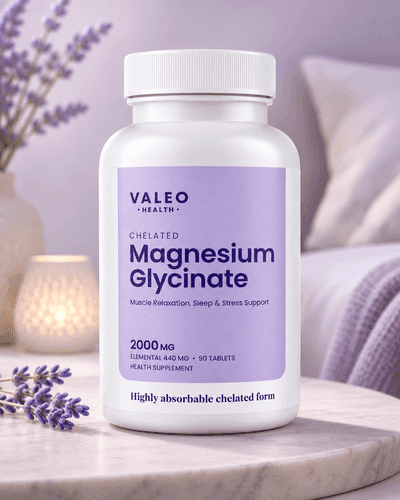
Valeo Health offers Chelated Magnesium Glycinate through its Kuwait online store.
The product is available in a 90-tablet package and is positioned for daily magnesium supplementation.
Valeo Chelated Magnesium Glycinate: Product Details
| Product Information | Details |
|---|---|
| Product name | Valeo Chelated Magnesium Glycinate |
| Form | Chelated magnesium glycinate |
| Pack size | 90 tablets |
| Listed elemental magnesium | 440 mg per two-tablet serving |
| Label instructions | Two tablets daily after meals, preferably spaced across the day |
| Delivery estimate | 1–2 days |
| Kuwait customer support | +965 5665 7426 |
| Contact method |
Important dosage consideration: The listed two-tablet serving provides 440 mg of elemental magnesium, which exceeds the usual adult upper limit of 350 mg per day from supplements and medications.
The amount suitable for an individual should be reviewed with a healthcare professional before using the full serving, particularly if the person takes other magnesium-containing products or has kidney concerns.
How Long Does Magnesium Glycinate Delivery Take in Kuwait?
The Valeo Kuwait online store currently lists an estimated delivery time of 1 to 2 days for Chelated Magnesium Glycinate.
Delivery estimates may vary depending on product availability, the delivery address and operational conditions.
Customers should confirm the expected delivery timeframe during checkout.
How Can You Contact Valeo Kuwait?
For questions about product availability, delivery, serving instructions or purchasing assistance, contact the customer support team on WhatsApp.
WhatsApp: +965 5665 7426
Before ordering, review the product label and discuss any concerns about magnesium dosage or medication interactions with your healthcare professional.
Conclusion
Magnesium is essential for normal muscle function, nerve activity, energy metabolism and bone health.
Although magnesium glycinate is commonly associated with sleep and relaxation, it should not be considered a guaranteed treatment for insomnia, muscle cramps or stress.
For adults in Kuwait, choosing a supplement should begin with understanding dietary intake, checking elemental magnesium content and considering personal health needs.
Valeo Health provides a chelated magnesium option for customers interested in reviewing their supplementation choices, along with online ordering and customer support in Kuwait.
For more information about magnesium forms, daily intake and safety considerations, explore Valeo Health's detailed guide to magnesium glycinate.
Sources and References
- National Institutes of Health, Office of Dietary Supplements. Magnesium: Fact Sheet for Health Professionals. Updated January 2026.
- National Institutes of Health, Office of Dietary Supplements. Magnesium: Consumer Fact Sheet.
- Garrison SR et al. (2020). Magnesium for Skeletal Muscle Cramps. Cochrane Database of Systematic Reviews.
- Mah J and Pitre T. (2021). Oral Magnesium Supplementation for Insomnia in Older Adults: A Systematic Review and Meta-Analysis. BMC Complementary Medicine and Therapies.
- Lopresti AL et al. (2026). Magnesium Supplementation for Sleep in Adults: A Systematic Review of Randomized Controlled Trials. Journal of Dietary Supplements.
Related Articles
Suggested Valeo Health Hub topics:
- Understanding Magnesium Deficiency and Its Symptoms
- Magnesium Glycinate: Benefits, Uses, Dosage and Kuwait Guide
- Foods Rich in Magnesium for Everyday Nutrition
About the Author
May Chalhoub
Nutritional and dietetic counselling
★ 4.89 (380 Reviews)
May Chalhoub is a licensed dietitian with a master's degree in human nutrition. Her journey in the field has included pivotal roles, such as a research and teaching assistant at LAU, where she contributed to significant projects, including a UN-funded community initiative.
Additionally, she has been instrumental in creating accredited workshops for dietitians and providing comprehensive training.
Currently, May is a dedicated Health Coach at Valeo, where she evaluates client progress, provides guidance, and contributes her expertise through insightful blogs on the Valeo HealthHub.
Qualifications and Certifications
Masters in Human Nutrition
Body Composition Analysis Certification
Breastfeeding and IYCF Practices Certification
Food Safety Portion Size Control Certification
Medical Review
Expert reviewed by May Chalhoub, Certified Nutritionist, Licensed Dietitian & Health Coach, with a focus on nutrition, healthy hair growth and nutritional factors that may contribute to hair loss.