

Collagen Peptides in Kuwait: What They Are, Types and How to Choose the Right One
Shopping for collagen sounds simple until you start reading the labels. One tub says collagen, another describes a hydrolysed form, another says marine peptides, and a fourth advertises several collagen types in one formula.
Those terms are related, but they do not always tell you the same thing.
If you are comparing collagen peptides in Kuwait, the most useful questions are practical: Where does the collagen come from? Has it been hydrolysed? Which collagen type does it provide? How many grams are in each serving? Are there allergens, flavourings or other ingredients you need to know about?
This guide explains the terminology, collagen types, marine versus bovine sources, molecular weight, serving size and label checks that actually help you compare products.
Quick Answer: What Are Collagen Peptides?
Collagen peptides are smaller protein fragments created when collagen is broken down through hydrolysis. This processing reduces the large collagen protein into shorter peptide chains that are easier to dissolve and digest.
During digestion, collagen-derived proteins and peptides are broken down further into amino acids and smaller peptides that can be absorbed through the gastrointestinal tract.
On supplement labels, collagen peptides and hydrolysed collagen are often used to describe the same general processed form of collagen.
For anyone comparing collagen peptides in Kuwait, the most important label details are the source, type, actual amount per serving, allergen declaration and complete ingredient list.
Collagen vs Hydrolysed Collagen: What Is the Difference?
Collagen is one of the body's main structural proteins. It is found in skin, bone, tendons, ligaments, cartilage and other connective tissues.
Native collagen has a large triple-helix structure. Hydrolysis breaks that structure into smaller fragments, producing the form commonly used in powders, sachets, drinks and capsules.
The difference is therefore mainly one of processing and peptide size rather than a completely different substance.
A product that simply says “collagen” may still contain a processed form, so read the ingredient panel instead of relying on the front label alone.
What Do the Different Collagen Terms Mean?
Collagen is the broad term for the structural protein.
Hydrolysed collagen means the collagen has undergone hydrolysis and has been broken into smaller fragments.
Hydrolyzed collagen is the American spelling of the same term.
Collagen hydrolysate is another label term used for this processed form.
Collagen peptides refers to the shorter peptide chains produced after hydrolysis.
Manufacturers may use different wording, but the ingredient list and amount per serving tell you more than whichever phrase appears in the largest font.
What Happens After You Take Collagen?
Collagen does not travel directly from a drink to your skin, hair or joints and insert itself into those tissues.
After you consume it, stomach acid and digestive enzymes break the protein into amino acids and smaller peptide fragments. Some small collagen-derived peptides can be detected in the bloodstream after ingestion.
Once absorbed, those nutrients become part of the body's available amino-acid and peptide pool. The body determines where they are used.
Researchers are also studying whether specific collagen-derived peptides may act as signals to cells involved in connective-tissue metabolism. That mechanism is interesting, but it should not be turned into a promise that every collagen supplement produces a specific visible result.
Can Collagen Peptides Support Skin Health?
Several clinical trials have reported changes in measures such as skin hydration or elasticity after regular oral collagen supplementation, but results vary between studies.
Product formulation, dose, peptide profile, study duration, participant characteristics and study quality all influence the findings.
A realistic interpretation is that collagen supplementation may support certain skin parameters in some people, but it should not be presented as a guaranteed treatment for wrinkles or skin ageing.
Sun protection, adequate protein and micronutrients, sleep, smoking status, hydration and overall health remain important parts of skin care.
What Are Collagen Types I, II and III?
Many collagen types exist in the human body, but Types I, II and III are the ones most often discussed on supplement labels.
Type I Collagen
Type I is the most abundant collagen type in the body. It is an important structural component of skin, bone, tendons and ligaments.
Marine collagen is generally rich in Type I, which is one reason fish-derived products are often chosen for skin-focused routines.
Type II Collagen
Type II collagen is associated mainly with cartilage.
Some joint-focused supplements use Type II collagen. Undenatured Type II is different from standard collagen powders and is generally used in much smaller quantities because it is intended to work through a different mechanism.
Type III Collagen
Type III is found in tissues including skin and blood vessels and commonly occurs alongside Type I.
Bovine collagen preparations often provide Types I and III.
Are Multi-Type Collagen Products Better?
Not automatically.
A formula listing Types I, II, III, V and X may sound more comprehensive, but the number of collagen types does not tell you whether the product is right for your goal.
Ask what source is used, how many grams of collagen the serving provides, whether the form is hydrolysed, whether individual amounts are disclosed, and whether the formula fits the reason you are taking it.
A clear, focused formula can be more useful than a complicated blend with small or undisclosed amounts of many ingredients.
Marine Collagen in Kuwait: What Makes It Different?
Marine collagen is usually derived from fish skin, scales or other fish-based materials and is commonly rich in Type I collagen.
For consumers comparing marine collagen in Kuwait, source may matter because of dietary preferences, collagen type, allergies and personal wellness goals.
Some people prefer a fish-derived source rather than bovine or porcine ingredients. Others choose marine collagen because Type I is an important structural component of skin.
Anyone with a fish allergy should check the allergen statement carefully.
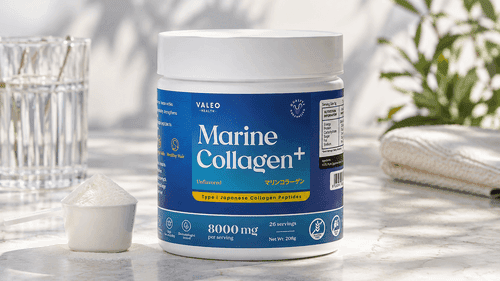
If you prefer an unflavoured option that can be added to coffee, smoothies or juice, the Valeo Health marine collagen peptide supplement in Kuwait can fit into a flexible daily routine.
If you prefer mixing your serving directly with water, the Valeo Health mango marine collagen supplement in Kuwait offers a flavoured alternative.
Marine Collagen vs Bovine Collagen
Neither source is automatically better for everyone.
Marine collagen is fish-derived and is commonly rich in Type I. Bovine collagen is derived from cattle and commonly supplies Types I and III.
Your choice may depend on your goal, dietary preferences, allergies, sourcing requirements, product quality, dose per serving, taste and cost.
Source is useful for narrowing the options, but it should not replace a full label comparison.
Is Marine Collagen Automatically Halal?
Marine sourcing and halal certification are different questions.
A fish-derived ingredient may fit particular dietary preferences, but certification can also consider processing, manufacturing, handling, additional ingredients and the wider supply chain.
If halal certification matters to you, look for an appropriate certification mark or verified manufacturer information rather than assuming certification based on source alone.
This is especially useful when comparing marine collagen in Kuwait, where source and processing may both influence the buying decision.
What Does Molecular Weight Mean on a Collagen Label?
Some collagen products display molecular weight in daltons, often shown as Da.
A lower molecular weight generally indicates shorter peptide fragments and can provide information about how extensively collagen has been hydrolysed.
It is still only one quality clue.
A 2,000 Da product is not automatically twice as effective as a 4,000 Da product. Dose, peptide profile, source, formulation, study evidence and consistency of use also matter.
Use molecular weight as part of the comparison, not as a ranking system.
How to Read a Collagen Nutrition Label Properly
One of the most common mistakes is assuming scoop size equals collagen dose.
A 10-gram scoop may contain 10 grams of collagen, or it may contain collagen plus flavouring, sweeteners, vitamins and other ingredients.
When comparing collagen powder in Kuwait, find the actual grams of collagen or collagen peptides listed per serving.
Then check:
collagen grams per serving
number of servings per container
serving size
collagen source
collagen type
added ingredients
sweeteners or added sugar
allergen information
certification where relevant
cost per serving
This gives you a much more useful comparison than looking at tub size alone.
How Much Collagen Is Commonly Used in Research?
There is no universal collagen dose for every formulation or purpose.
Skin-focused clinical studies have used different amounts, often in the range of a few grams per day depending on the product and research design.
That is why copying the scoop size from another brand does not always make sense.
Follow the directions of the product you are actually using unless a qualified healthcare professional recommends something different.
How to Choose Collagen Powder in Kuwait
When choosing collagen powder in Kuwait, focus on information you can verify.
Check the source, type and degree of processing. Review the grams per serving and the full ingredient list. Look for allergens, certification where relevant, number of servings and price per serving.
Then consider the format.
An unflavoured product may be easier to add to coffee, smoothies or juice. A flavoured product can be more convenient if you prefer to mix your serving directly into water.
The best product for your routine is one you can use consistently.
Can You Take Collagen With Glutathione?
Collagen and glutathione are different compounds and should not be treated as interchangeable.
Collagen provides a specific amino-acid and peptide profile. Glutathione is an antioxidant involved in different biological processes.
If you are building a broader skin-focused routine, you may separately explore the Valeo Health glutathione supplement for skin wellness in Kuwait.
That does not mean everyone using collagen needs glutathione. Each supplement should have a clear purpose.
Can You Combine Collagen With Hair Supplements?
Yes, but check the ingredient lists before combining products.
Some hair formulas already contain marine collagen, vitamins, minerals or other nutrients that may overlap with what you are already taking.
If hair is a separate priority, compare your current routine with a Valeo Health Hair+ supplement in Kuwait with marine collagen before adding several beauty products at once.
A targeted routine is usually easier to understand and maintain than a long list of supplements with overlapping ingredients.
Can Collagen Be Part of a Broader Daily Wellness Routine?
It can, but a larger supplement stack is not automatically a better one.
If your goals extend beyond skin and hair, evaluate other products separately according to their own purpose.
For example, someone looking at broader nutritional support may compare collagen with a Valeo Health omega-3 supplement for daily wellness in Kuwait, rather than expecting collagen to address unrelated nutritional needs.
Choose each supplement because it fits a defined goal, not simply because it can be taken alongside another product.
Does Collagen Count as Your Daily Protein?
Collagen is a protein, but it does not provide a complete balance of essential amino acids.
It should not replace high-quality dietary protein sources such as eggs, dairy, meat, fish or appropriately combined plant proteins.
Think of collagen as a specialised protein supplement rather than the foundation of your daily protein intake.
How Long Does Collagen Take to Work?
Collagen is not an overnight supplement.
Many skin-focused studies assess outcomes after approximately 8 to 12 weeks of consistent intake.
Individual results vary according to age, diet, lifestyle, product formulation, dose, baseline skin condition and consistency.
Hair and nail changes can take longer to notice because both grow slowly.
Who Should Be Careful With Collagen Supplements?
Speak with a healthcare professional before using collagen if you:
have a fish allergy and are considering marine collagen
have another relevant food allergy
are pregnant or breastfeeding
have been advised to restrict protein
have kidney disease or another significant medical condition
use medicines or supplements that require dietary monitoring
Always read the full ingredient panel, especially with flavoured products.
Final Thoughts: How Should You Choose Collagen Peptides?
The word peptides tells you something useful about how collagen has been processed, but it does not prove that one product is automatically superior.
For anyone comparing collagen peptides in Kuwait, focus on source, collagen type, grams per serving, ingredient transparency, allergens and relevant certification.
When comparing marine collagen in Kuwait, look at the actual serving and product quality rather than beauty-focused marketing alone.
And when choosing collagen powder in Kuwait, pick a format you can realistically use consistently.
A clear label, an appropriate source and a sustainable routine matter more than an unnecessarily complicated formula.
Medically Reviewed By: Dr. Rayan Mohammed, General Practitioner at Valeo Health
Reviewed for medical accuracy, safety guidelines, and healthcare recommendations.